


What to Include in a Prototype Manufacturing RFQ: CAD Files, Materials, Tolerances and NDA?
Missing details in a prototype RFQ delay your quotes and ruin your schedule. Have you ever waited weeks for a price only to receive confusing questions back?
A complete prototype manufacturing RFQ must include a signed NDA or NNN agreement, native and neutral 3D CAD files with 2D drawings, specific material grades, surface finish standards, critical tolerances, order quantities, and target delivery dates to ensure fast and accurate pricing.
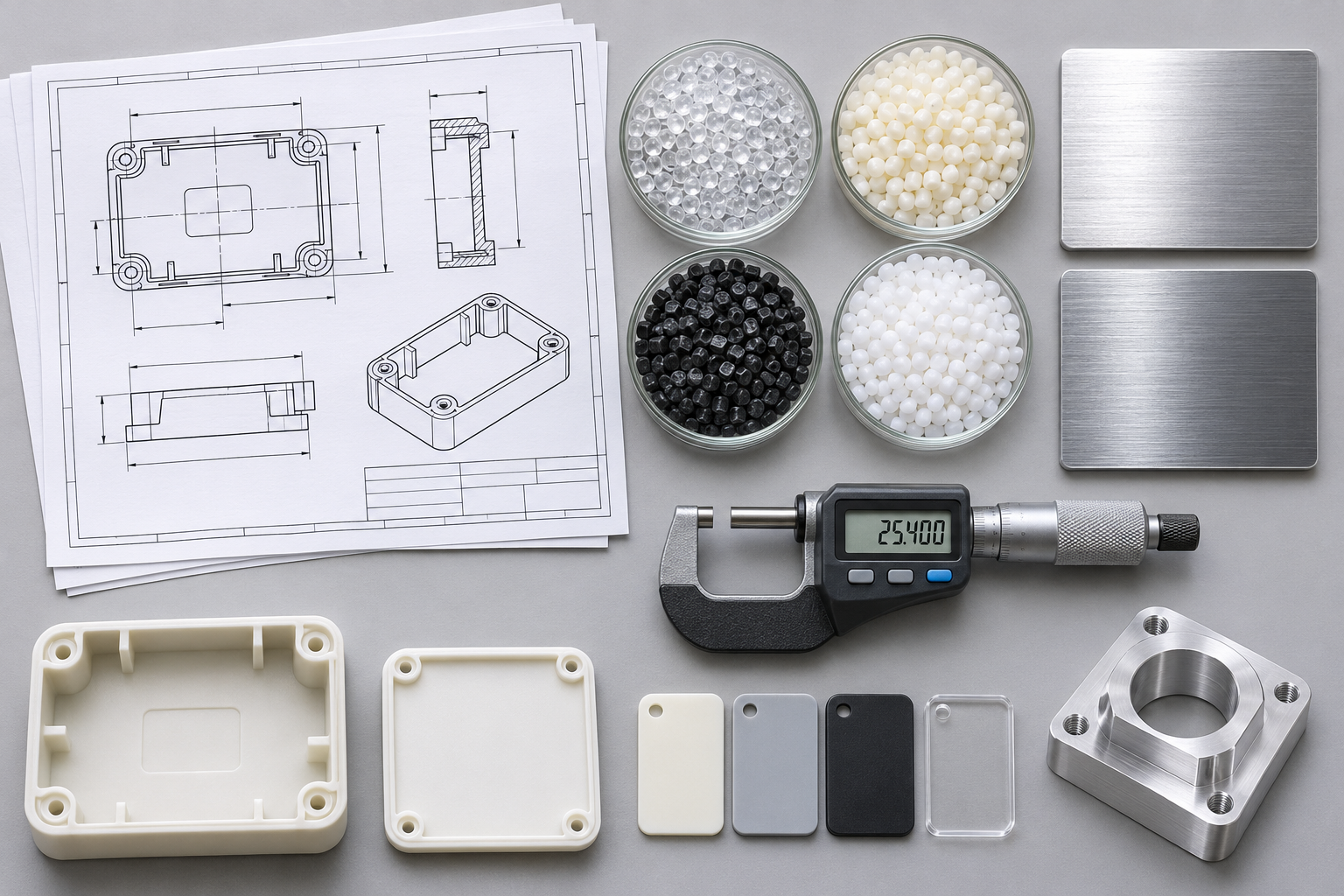
I see engineering teams lose months on new product launches because their initial quote packages are incomplete. When you send clear files from day one, factories quote faster and avoid costly mistakes. Let us look at every single item your package needs so you can get accurate numbers right away.
What Should You Sign Before Sending Prototype CAD Files? (NDA vs. NNN)
Sharing your new product design with an overseas factory feels risky. If someone steals your CAD files, you lose your market advantage before you even launch.
Before sending prototype CAD files to a manufacturer in China or Asia, you should sign an NNN (Non-Disclosure, Non-Use, Non-Circumvention) agreement rather than a standard Western NDA, as NNN agreements prevent the factory from copying, selling, or bypassing you.

Why Western NDAs Fail Overseas
A standard US NDA only stops a factory from telling secrets to the public. It does not stop them from making your product and selling it on their own. Last month, a client came to our engineering team after another shop copied his housing design because his basic NDA had no local enforcement power. At Kenvox, we always sign bilingual NNN agreements before looking at any client files.
Three Protections Inside an NNN
You need three clear rules in your contract so your intellectual property stays safe during prototyping and mass production:
| Agreement Type | Protects Against Leaks | Stops Factory From Copying | Stops Factory From Selling Direct | Enforceable in China |
|---|---|---|---|---|
| Standard NDA | Yes | No | No | Weak |
| NNN Agreement | Yes | Yes | Yes | Strong |
Make sure your NNN is written in both English and Chinese. Also, set the governing law to the country where the factory operates so local courts can freeze their assets if they break the rules.
Which CAD File Formats Are Best for Prototype Manufacturing?
Sending the wrong CAD file format forces engineers to guess your design intent. Bad file exports create broken surfaces, missing holes, and slow quote replies.
The best CAD files for a prototype RFQ are STEP (.stp) or IGES (.igs) for 3D geometry, paired with a detailed 2D PDF drawing for tolerances and threads, plus native files like SolidWorks when complex surfacing requires direct editing.

Choosing Between 3D Neutral and Native Files
I always ask designers to send both a 3D solid model and a 2D print. A 3D STEP file lets our CNC and mold engineers check wall thickness and draft angles quickly. However, a 3D file alone never shows thread sizes or tight hole fits. If you only send a STEP file, our project leaders have to email you back and ask questions, which wastes two or three days.
File Formats by Manufacturing Process
Different machines read different files, so matching your export format to the process saves time:
| File Format | File Extension | Best Use Case | Key Advantage |
|---|---|---|---|
| STEP | .stp / .step | CNC machining, injection molds | Keeps clean solid geometry across all CAD tools |
| 2D Drawing | .pdf / .dwg | Tolerances, threads, surface notes | Shows critical dimensions that 3D models lack |
| Native CAD | .sldprt / .prt | Complex organic shapes, mold flow | Allows direct feature tree edits without errors |
| STL | .stl | 3D printing only | Fast mesh export for quick visual checks |
Never send an STL file for CNC machining or injection molding. STL files turn smooth curves into flat triangles, which ruins your final part appearance.
How Do You Specify Materials and Surface Finishes in an RFQ?
Writing "plastic" or "aluminum" on your RFQ leads to wildly different quotes from suppliers. You cannot compare prices fairly when each factory quotes a different raw material.
Specify exact material grades such as Sabic Lexan 940 or Aluminum 6061-T6, alongside recognized surface finish standards like SPI-A2 for polish, VDI 3400 for texture, or bead-blasted anodizing, so every manufacturer quotes the exact same specification.
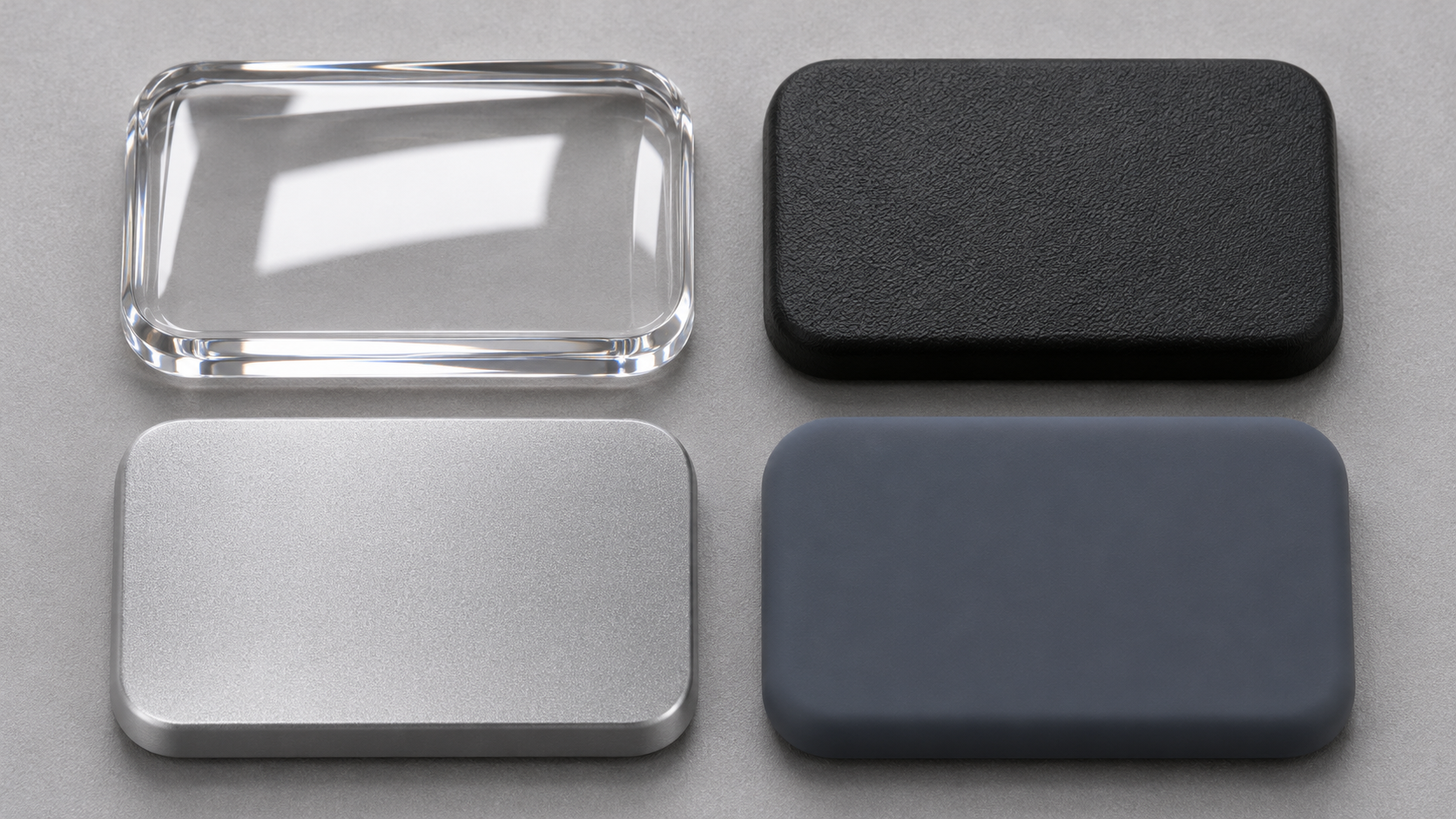
Naming Exact Resin and Metal Grades
General names cause huge performance issues later. For example, standard ABS costs much less than flame-retardant PC/ABS, and they shrink at different rates in a mold. I once reviewed a consumer electronics shell where the buyer just wrote "black plastic." One shop quoted cheap recycled PP, while we quoted virgin UL94 V-0 ABS. Always list the brand, grade, color code (Pantone or RAL), and any UL or FDA rules.
Standardizing Surface Finishes
Words like "smooth" or "matte" mean different things to different people. Use industry codes so your prototype matches your final vision:
| Material Group | Finish Standard | Common Code Example | Visual Result |
|---|---|---|---|
| Plastic / Molded | SPI Polish | SPI-B1 / SPI-A2 | Semi-gloss to mirror clear finish |
| Plastic / Molded | VDI 3400 / Mold-Tech | VDI 27 / MT-11010 | Fine matte texture that hides scratches |
| CNC Metal | Surface Roughness | Ra 1.6 µm / Bead Blast | Clean uniform satin metal look |
| Silicone (LSR) | Matte / Gloss | Molded texture + matte oil | Soft-touch feel that resists dust |
If you plan to move from CNC prototypes to injection molding later, tell your supplier now. We can match the CNC bead-blast finish to the VDI mold texture you will use in mass production.
How Tight Should Tolerances Be on a Prototype Drawing?
Putting ultra-tight tolerances on every dimension doubles your prototype machining cost. Factories have to run machines slower and inspect every single part by hand.
Apply standard ISO 2768-m tolerances for general prototype features, and reserve tight tolerances like ±0.02 mm or ±0.05 mm strictly for mating parts, bearing bores, and sealing surfaces where function depends on precision.
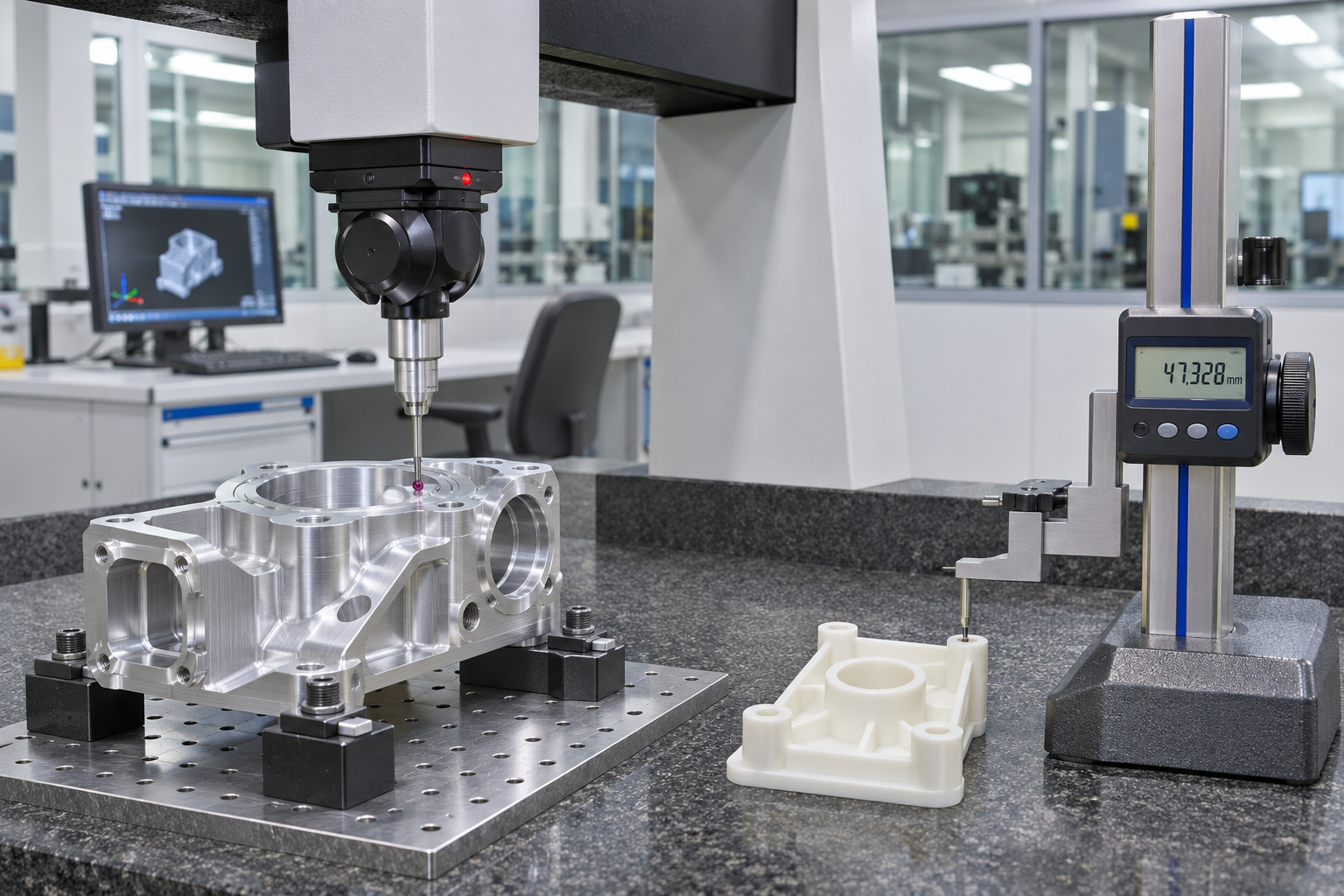
The Real Cost of Over-Tolerancing
Every extra decimal place on a 2D drawing adds real money to your quote. When I see a title block with ±0.01 mm on every wall of a simple plastic bracket, I know the designer forgot to adjust their CAD template. Holding ±0.01 mm on plastic is nearly impossible because plastic expands and shrinks with room temperature. You end up paying for wasted hours on slow CNC paths and CMM checks.
Practical Tolerance Guidelines
Focus your budget on the areas where parts touch, slide, or seal against each other:
| Feature Type | Recommended Tolerance | Process Capability | Cost Impact |
|---|---|---|---|
| General Non-Mating Walls | ISO 2768-m (±0.1 to ±0.3 mm) | Standard CNC & Molding | Baseline (1x) |
| Snap-Fits & Alignment Pins | ±0.05 mm | Precision CNC & Tooling | Moderate (1.2x – 1.5x) |
| Bearing Bores & Seal Grooves | ±0.015 to ±0.025 mm | High-speed CNC & Grinding | High (2x – 3x) |
| Silicone / Rubber Parts | ISO 3302-1 Class M2 | LSR & Compression Molding | Baseline for elastomers |
Mark your critical dimensions with a balloon or "CTQ" (Critical to Quality) symbol on the 2D PDF. Our quality team uses those exact marks to build your CMM inspection report.
What Quantities and Delivery Details Do Manufacturers Need to Quote?
Asking for a price on "a few prototypes" makes it hard for a factory to pick the right manufacturing method. Setup costs change completely depending on whether you need five parts or five hundred.
Provide tiered prototype quantities (such as 5, 50, and 500 units), your estimated annual volume (EAU), target delivery date, and shipping destination with Incoterms so the factory can recommend the most cost-effective process.

Why Volume Tiers Change the Process
A smart manufacturer looks at both your immediate prototype run and your future mass production plan. If you only need 5 plastic parts, CNC machining makes total sense because there is zero tooling cost. However, if you need 300 silicone keypads or 500 plastic housings for user testing, a soft aluminum sample mold or silicone vacuum casting costs far less per part than CNC. Sharing your EAU helps us design a bridge path that scales smoothly.
Logistics Details That Impact Final Cost
Shipping heavy metal prototypes by air express can sometimes cost more than the parts themselves. Include these four details in your RFQ email:
| Detail Needed | Example Input | Why It Matters for Quoting |
|---|---|---|
| Prototype Tier | 5 pcs / 50 pcs / 200 pcs | Determines CNC vs. soft tooling vs. 3D printing |
| Future EAU | 50,000 units per year | Guides mold steel choice and cavity count |
| Target Lead Time | 10 working days | Identifies if rush overtime or express air is needed |
| Incoterms & Address | DDP Los Angeles / FOB Shenzhen | Calculates duties, freight, and local tax accurately |
When clients give us clear target dates at Kenvox, our project leaders map out the exact schedule from raw material cutting to T0 sample shipping on day one.
How Can DFM Review Reduce Your Prototype Manufacturing Cost?
Prototypes often fail because designers focus only on how a part looks on a computer screen. Ignoring how a cutter or mold reaches a feature leads to expensive redesigns later.
A Design for Manufacturability (DFM) review reduces prototype costs by identifying deep narrow pockets, sharp internal corners, uneven wall thicknesses, and missing draft angles before cutting metal, saving up to 30% on machining and future tooling.

Catching Expensive Geometry Early
Last year, an industrial design team sent us a handheld device housing with 25 mm deep slots that were only 1 mm wide. Machining that slot required tiny, fragile end mills that broke repeatedly and added ten hours of machine time. During our free DFM review, we suggested widening the slot to 2.5 mm and adding a 1.5 mm corner radius. That single change cut their prototype cost by 35% and prepared the part for injection molding.
Top Four DFM Fixes We Recommend
Before you lock your prototype design, check these four common trouble spots:
| Design Issue | Problem in Production | Simple DFM Fix |
|---|---|---|
| Sharp Internal Corners | Round CNC tools cannot cut 90-degree inside corners | Add an internal radius of at least 1/3 the pocket depth |
| Zero Draft Angles | Parts stick inside molds and scratch during ejection | Add 1° to 2° of draft on all vertical plastic walls |
| Thick Wall Sections | Causes sink marks, warping, and long cooling cycles | Keep plastic walls uniform between 1.5 mm and 3.0 mm |
| Deep Undercuts | Requires expensive side-actions or lifters in molds | Redesign snap-fits as pass-through features where possible |
Never treat your prototype as a standalone step. Ask your supplier to review the part for both prototype machining and future mass production tooling at the same time.
Ready to Request a Prototype Quote? (Checklist & Next Steps)
Sending a messy folder full of random files slows down your project before it even starts. A clean, organized RFQ package gets fast attention from senior engineers.
Use a pre-submission checklist to verify your NNN agreement, 3D STEP files, 2D PDF drawings, material specs, CTQ tolerances, and volume tiers are bundled in one clear folder before requesting quotes from qualified manufacturers.

How to Organize Your RFQ Folder
I always tell engineers to put themselves in the estimator’s shoes. At our Shenzhen engineering office, a clean zip file gets routed to a project leader within an hour, while an incomplete email sits in a queue waiting for answers. Name your files clearly using your part number and revision letter, such as PN1004-RevB-Housing.stp and PN1004-RevB-Housing.pdf.
Final Pre-Quote Checklist
Check off every item below before you hit send on your next prototype RFQ:
| Item Category | Deliverable Required | Quick Verification Check |
|---|---|---|
| IP Protection | Bilingual NNN Agreement | Signed and stamped by the factory before sending CAD |
| 3D Geometry | STEP (.stp) or Native CAD | Solid body with no missing surfaces or open edges |
| 2D Print | PDF Drawing | Lists title block, revision, threads, and CTQ tolerances |
| Specs & Finish | Material & Color Notes | Exact resin/alloy grade plus SPI, VDI, or Ra finish code |
| Commercials | Quantities & Target Date | Tiered qty (e.g., 10 / 100 pcs), EAU, and DDP address |
Once your folder is ready, upload your files to our engineering team at www.kenvox.com. We will review your geometry, share a full DFM report, and send you a clear quote within 24 hours.
Conclusion
A complete RFQ with an NNN, STEP files, 2D prints, exact materials, smart tolerances, and volume tiers gives you fast, accurate prototype quotes and prevents costly production delays.