


How to Evaluate a Prototyping Supplier for Low-Volume Production?
Choosing the wrong prototyping supplier drains your budget and delays your launch. Missed tolerances and poor communication turn simple design validations into costly, frustrating manufacturing nightmares.
To evaluate a prototyping supplier for low-volume production, verify their in-house equipment capabilities, ISO quality certifications, and DFM engineering support. Look for direct engineer communication, transparent tooling pricing, and scalable capacity from CNC machining or sample molds into full mass production.

I have spent over three decades helping product designers bridge the gap between initial CAD files and finished parts. You need a partner who treats small batches with mass-production rigor, so let us break down the exact metrics you should check before signing a contract.
What is considered low volume in manufacturing?
Many designers struggle to find factories willing to run small batches without charging massive setup fees. Standard mass-production factories often reject small orders, leaving your product stuck in development limbo.
In manufacturing, low-volume production typically ranges from 50 to 10,000 parts per run. This bridge phase sits between one-off rapid prototypes and high-volume mass production, allowing teams to test market demand, validate assembly fits, and refine designs without investing in expensive multi-cavity hardened steel tooling.

When I review projects at Kenvox, I see a huge difference between ordering five CNC parts and ordering 2,000 molded components. Different manufacturing methods fit different batch sizes, and a good supplier offers multiple pathways under one roof.
Production Volume Tiers
Understanding where your project sits helps you filter out suppliers that are either too small or too rigid. A pure prototype shop lacks assembly lines, while a massive factory ignores orders under 50,000 units.
- Rapid Prototyping (1–50 units): Best for initial form and fit checks using 3D printing or basic CNC machining.
- Low-Volume Bridge Production (50–10,000 units): Ideal for pilot runs, clinical trials, and early market launches using aluminum molds, soft steel tools, or silicone vacuum casting.
- High-Volume Mass Production (10,000+ units): Requires hardened steel injection molds designed for hundreds of thousands of cycles.
Matching Process to Quantity
Your supplier must guide you toward the right tooling investment based on your immediate volume goals.
| Quantity Range | Recommended Process | Typical Tooling Material | Primary Goal |
|---|---|---|---|
| 1 – 50 Parts | CNC Machining / 3D Printing | No Mold Required | Visual and basic mechanical testing |
| 50 – 500 Parts | Silicone Sample Molds / Urethane Casting | Liquid Silicone | Soft-touch parts and small market tests |
| 500 – 10,000 Parts | Rapid Injection Molding | Aluminum or P20 Steel | Functional validation with production resins |
Why is prototype testing important before full scale production?
Skipping physical prototype testing to save time almost always leads to catastrophic tooling rework later. Fixing a flawed steel mold after cutting metal costs thousands of dollars and ruins your launch schedule.
Prototype testing is critical before full-scale production because it uncovers hidden design flaws, validates material shrinkage, and confirms part assembly tolerances. Catching wall thickness issues or warpage early prevents expensive hardened-steel mold modifications and ensures your final product performs reliably in real-world conditions.
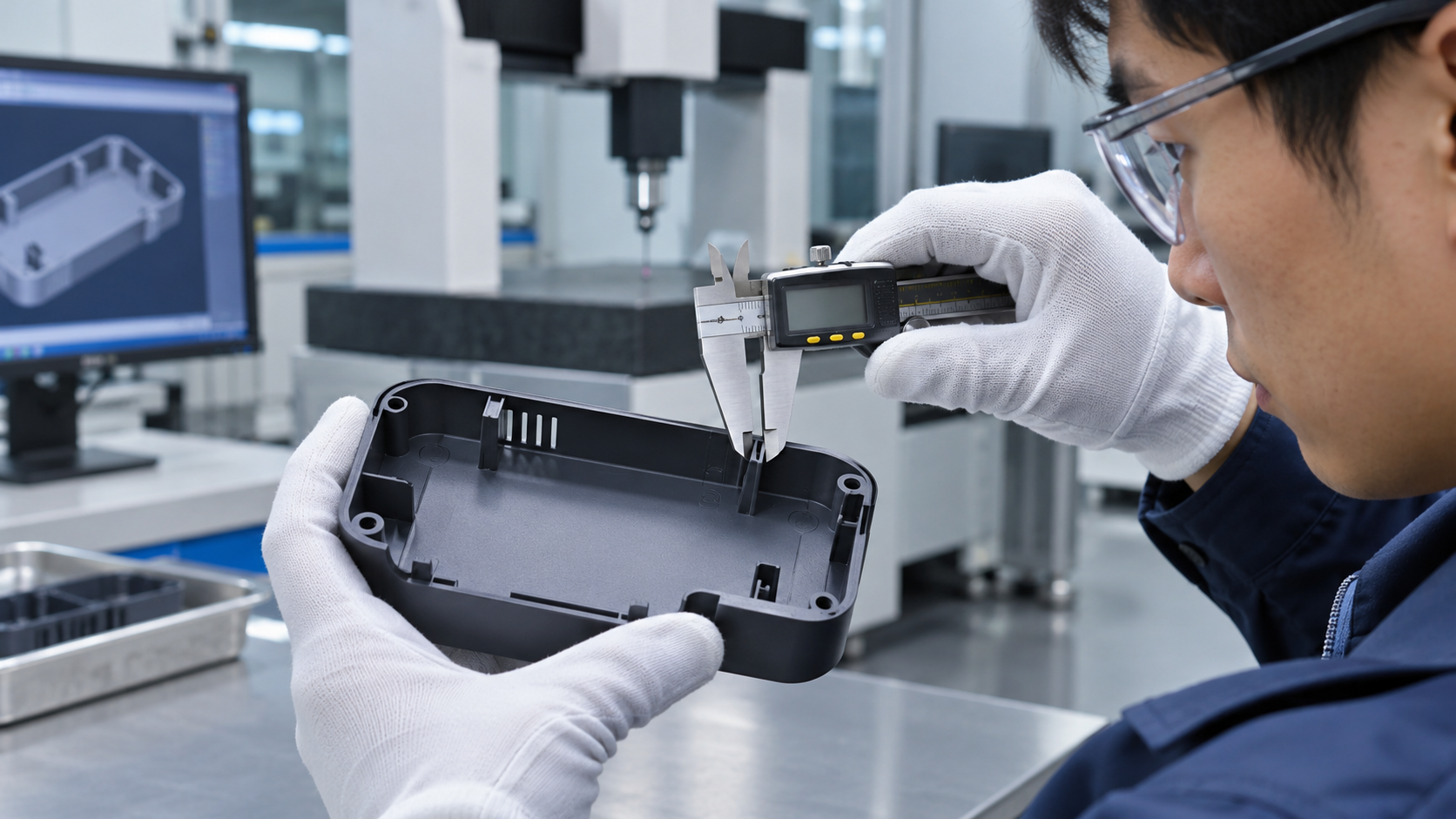
I remember working with a consumer electronics designer named Ryan who nearly committed to a multi-cavity steel mold for a new enclosure. We convinced him to run a quick CNC and soft-tool test first, which immediately revealed an unexpected snap-fit stress fracture.
Validating Material Shrinkage and Geometry
CAD models look perfect on a computer screen, but melted plastic behaves differently inside a metal cavity. Different resins shrink at different rates as they cool, which alters your critical dimensions.
- Wall Thickness Checks: Thick sections cause ugly sink marks, while thin walls prevent plastic from filling the cavity completely.
- Draft Angle Verification: Parts need proper draft angles so they eject cleanly from the mold without scratching or sticking.
- Assembly Tolerance Testing: Testing physical mating parts proves whether your clips, bosses, and threads actually fit together under stress.
Functional and Regulatory Readiness
Beyond basic geometry, physical prototypes let you run real-world drop tests, thermal cycles, and compliance checks. If your device requires UL, CE, or FDA approval, testing production-grade prototype parts gives you accurate performance data before you lock in your final design.
How much does it cost to get a prototype made?
Unclear prototyping quotes make it nearly impossible for product designers to forecast early development budgets accurately. Hidden setup charges, sudden material surcharges, and vague tooling ownership terms often blow up initial cost estimates.
Getting a prototype made costs anywhere from $50 for a simple 3D-printed part to $5,000 or more for a low-volume aluminum injection mold. Final pricing depends heavily on part geometry, material selection, surface finish requirements, tight dimensional tolerances, and the total batch quantity you order.

When you request a quote from a manufacturing group, you should see a clear breakdown between one-time non-recurring engineering costs and per-part unit prices. A trustworthy supplier never hides tooling fees inside inflated unit costs.
Key Factors Driving Prototype Costs
Every design decision you make inside your CAD software directly impacts how much machine time your part requires.
- Geometric Complexity: Deep ribs, internal undercuts, and sharp internal corners require slow-wire EDM or multi-axis CNC setups, driving up labor hours.
- Surface Finish Requirements: Requesting a mirror polish, custom bead-blast texture, or color-matched UV painting adds manual post-processing steps.
- Tolerance Tightness: Holding standard +/- 0.1 mm tolerances is fast and affordable, whereas demanding +/- 0.01 mm requires specialized CMM inspection and slower machining speeds.
Cost Comparison Table
Comparing different prototyping methods side-by-side helps you balance upfront tooling costs against per-piece prices for your specific batch size.
| Prototyping Method | Upfront Setup / Tooling Cost | Cost Per Unit | Lead Time | Best Use Case |
|---|---|---|---|---|
| Industrial 3D Printing | $0 – $50 | $20 – $150 | 2 – 5 Days | Fast shape and ergonomics check |
| CNC Machining | $50 – $200 | $40 – $300 | 5 – 10 Days | High-precision metal or engineering plastic |
| Silicone Sample Molds | $300 – $1,200 | $15 – $60 | 1 – 2 Weeks | Flexible elastomers and small batches |
| Low-Volume Injection Mold | $1,500 – $6,000 | $1 – $8 | 2 – 4 Weeks | Production-grade resin and bridge runs |
My insights
Working directly with overseas factories often feels risky when language barriers and middlemen slow down technical feedback. You need direct access to experienced engineers who take ownership of your design from day one.
From my 35 years in manufacturing, the best low-volume supplier is an actual factory group with in-house tooling, not a trading broker. Always demand a thorough DFM report before paying for tooling, verify their ISO quality systems, and confirm they can scale your project smoothly into mass production.

At Kenvox, we structured our entire engineering team to eliminate the communication gaps that frustrate product designers. When you send us a drawing, an experienced project leader reviews your file immediately rather than passing it through layers of non-technical salespeople.
Spotting Brokers vs. Real Manufacturers
Trading companies mark up your prices and relay your technical questions back and forth, causing costly misunderstandings. You can easily separate real factories from middlemen by asking a few direct questions during your evaluation.
- Ask for an Equipment List: Real manufacturers proudly share details about their high-speed CNC machines, mirror EDM units, and injection press tonnages.
- Request a Live Video Audit: Walk through their tool shop and molding floor via video call to verify their CMM inspection labs and clean-room facilities.
- Check Quality Certifications: Look for active ISO 9001 or IATF 16949 certificates that prove they maintain strict incoming-to-outgoing quality control.
The Power of Proactive DFM Support
A great prototyping supplier never blindly machines a flawed CAD file just to collect your money. Before cutting any metal, their engineers should deliver a detailed Design for Manufacturability report highlighting parting lines, gate locations, ejection pins, and potential shrinkage risks.
Conclusion
Evaluating a low-volume prototyping supplier requires checking their in-house tooling capacity, DFM engineering support, transparent pricing, and quality certifications so your product transitions smoothly from early testing into mass production.