


Injection Mold Life, Lead Time, and Cost: Realistic Expectations from Tooling to Mass Production
KENVOX (Kenvox Industrial), founded in 1989, specializes in precision injection molding and mold manufacturing. We hold ISO 9001, ISO 13485, and IATF 16949 certifications, operate production bases in Shenzhen and Dongguan, China, as well as Vietnam, and run 190+ injection molding machines. For purchasing and engineering teams, the three most common questions in a tooling project are: How long will the mold last, how long will it take to deliver, and what drives total cost? This guide provides typical ranges based on KENVOX project experience, explains key influencing factors, and includes a quote-preparation checklist to help you set executable expectations during project planning.
Note: The mold life, lead time, and cost figures below are typical reference ranges and do not constitute commitments for any specific project. Actual results depend on part geometry, material, precision, tolerances, surface requirements, mold steel, and production scheduling. Please refer to the DFM review and formal quotation for project-specific details.
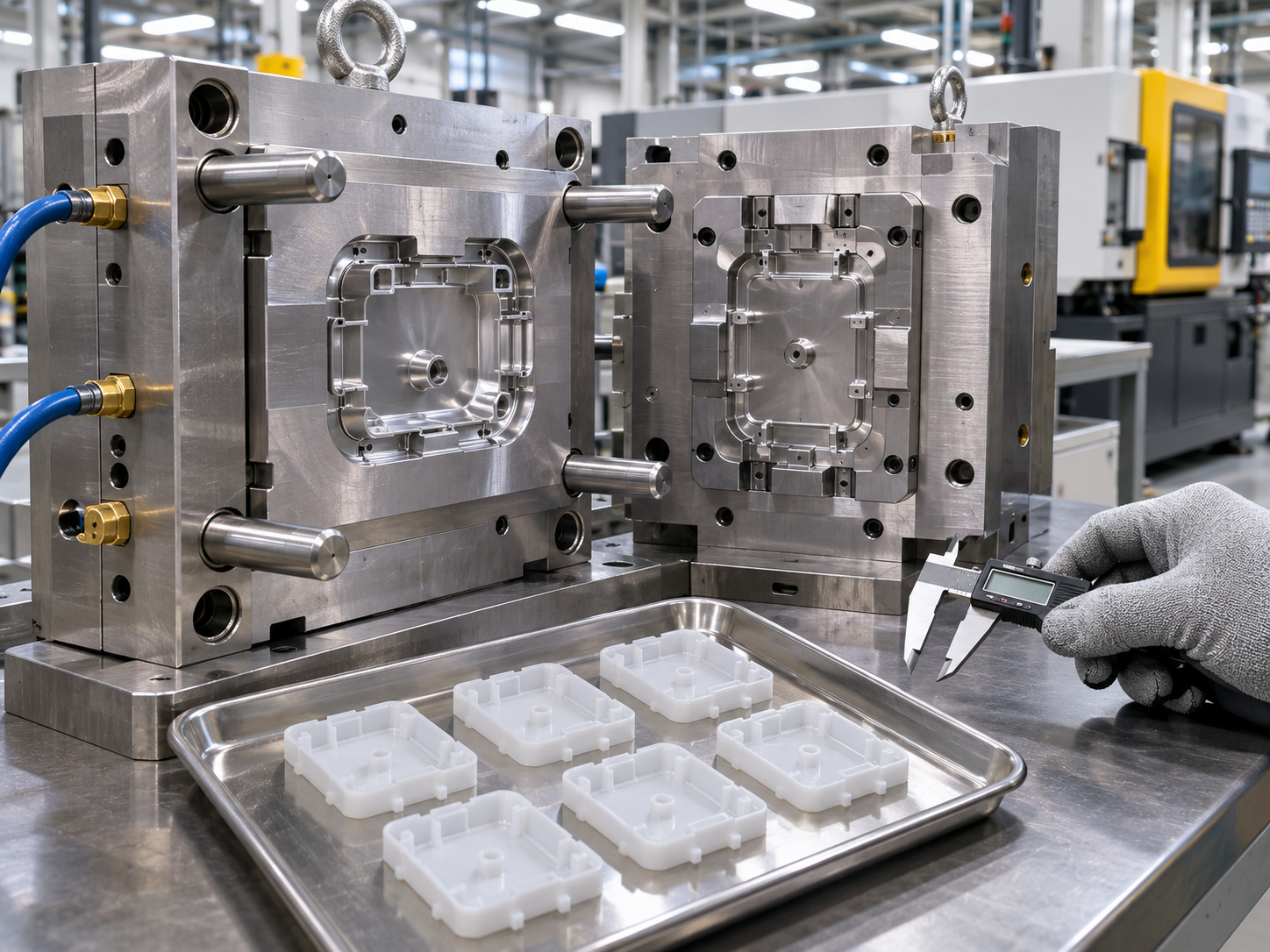
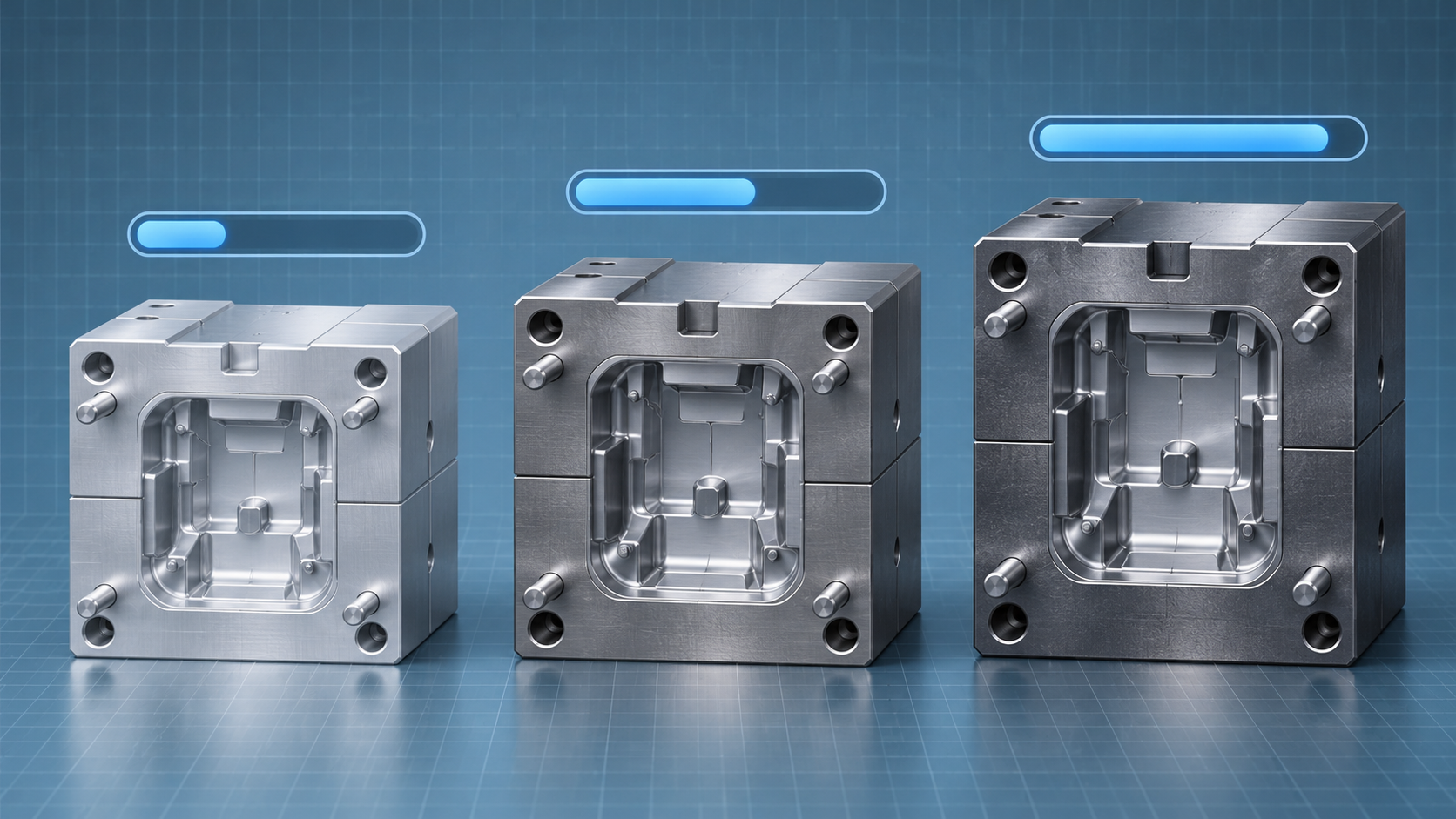
1. Mold Life: Typical Ranges and Classifications
Mold life is usually measured in shots and is affected by steel selection, heat treatment, plastic material (especially glass-filled or flame-retardant resins), and maintenance frequency.
| Mold Class (Typical) | Common Steel/Solution Examples | Typical Life Range | Suitable Applications |
|---|---|---|---|
| Prototype / Soft Tooling | Aluminum, mild steel (e.g., unhardened P20 solutions, project-dependent) | ~1,000 – 10,000 shots | Design validation, small pilot runs, pre-launch testing |
| Medium-Volume Production Mold | Pre-hardened steels such as P20 / 718H | ~100,000 – 300,000 shots | Consumer electronics, general industrial parts, volume-uncertain production |
| High-Life Production Mold | H13, S136, NAK80, etc. (depending on wear/polish/corrosion needs) | ~300,000 – 1,000,000+ shots | Automotive, medical, long-term stable production, high-cosmetic parts |
Key factors affecting mold life:
- Plastic material: Glass fiber, mineral fillers, or flame-retardant systems accelerate wear; corrosive materials (such as certain PVC/flame-retardant formulations) require higher corrosion resistance in mold steel.
- Structure and precision: Thin walls, high pressure, complex slides/lifters, and sharp rib features increase local stress and wear.
- Maintenance: Regular cleaning, lubrication, replacement of wear parts (ejector pins, springs, seals), and mold condition records can significantly extend effective life.
- Process window: Long-term over-packing, excessively high melt temperature, or improper ejection can shorten mold life.
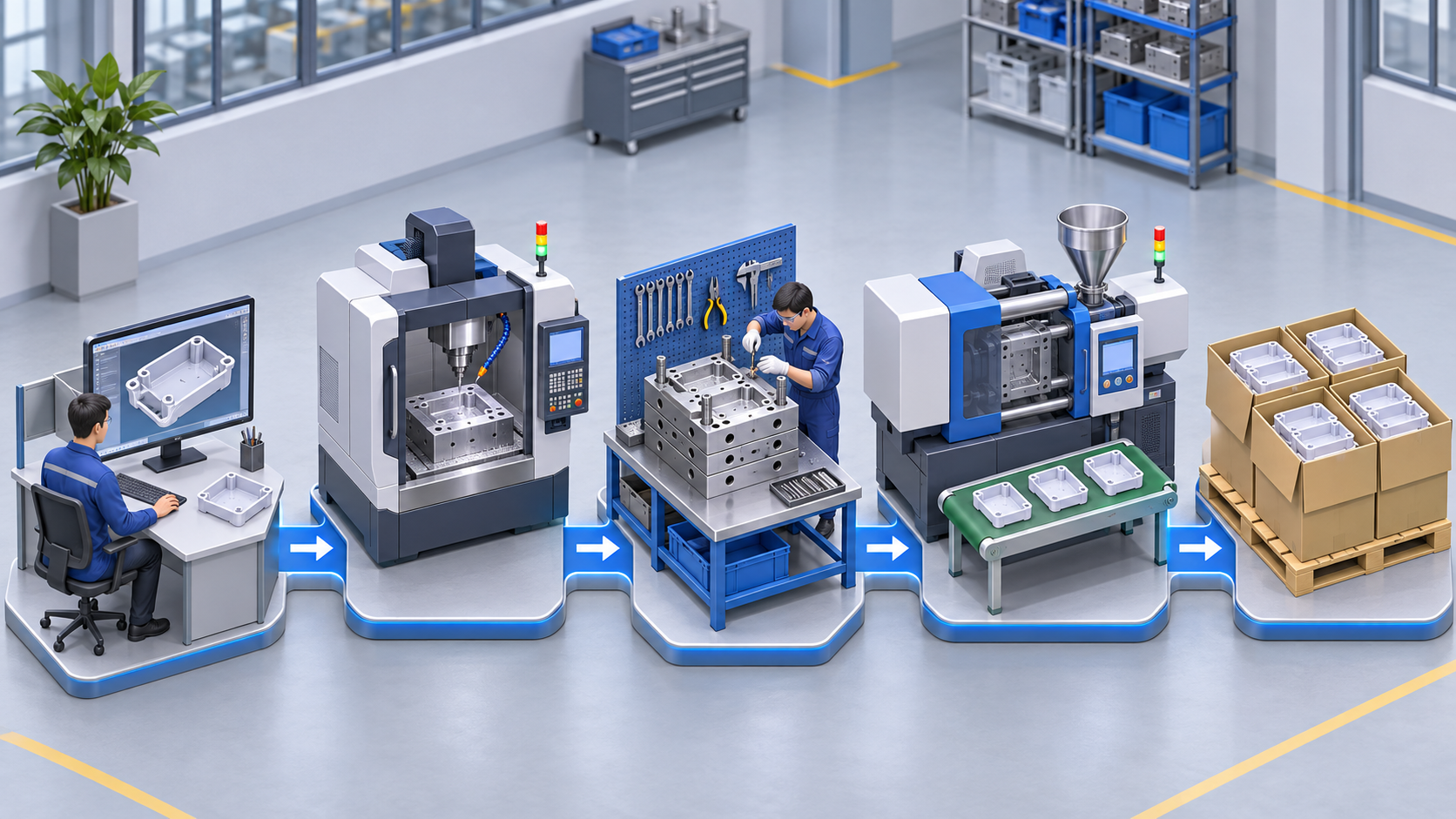
2. Tooling and Production Lead Time: From DFM to Shipment
Lead time is determined by design complexity, machining depth, number of trial rounds, and part validation requirements. At KENVOX (Kaiwo Industrial), the typical mold development cycle is 4–8 weeks, and mass production lead time is usually 2–4 weeks (subject to scheduling and order volume). Below is a common phase breakdown:
| Phase | Typical Time Range | Main Deliverables / Gates |
|---|---|---|
| DFM review & quotation confirmation | 2–5 business days | DFM report, mold plan, quotation, and timeline |
| Mold design | 3–7 days | 2D/3D mold drawings; cooling/gating/ejection plan confirmation |
| Steel procurement & machining | 2–4 weeks | CNC, EDM, wire cutting, polishing/texture, assembly |
| T1 trial & samples | 3–7 days (including trial scheduling) | First samples, trial report, initial dimensional/cosmetic check |
| Adjustments & validation (T2/T3 as needed) | 1–3 weeks | Dimensional corrections, cosmetic approval, process window confirmation |
| Pilot run / production ramp-up | 1–3 weeks | Stable process parameters, packaging and shipment process confirmation |
Factors that may extend lead time: Complex slides/lifters, multiple texture/cosmetic approvals, tight tolerances (requiring repeated mold corrections), medical/automotive validation documentation (such as IQ/OQ/PQ or PPAP-related support), material or steel procurement cycles, holidays, and cross-location coordination.
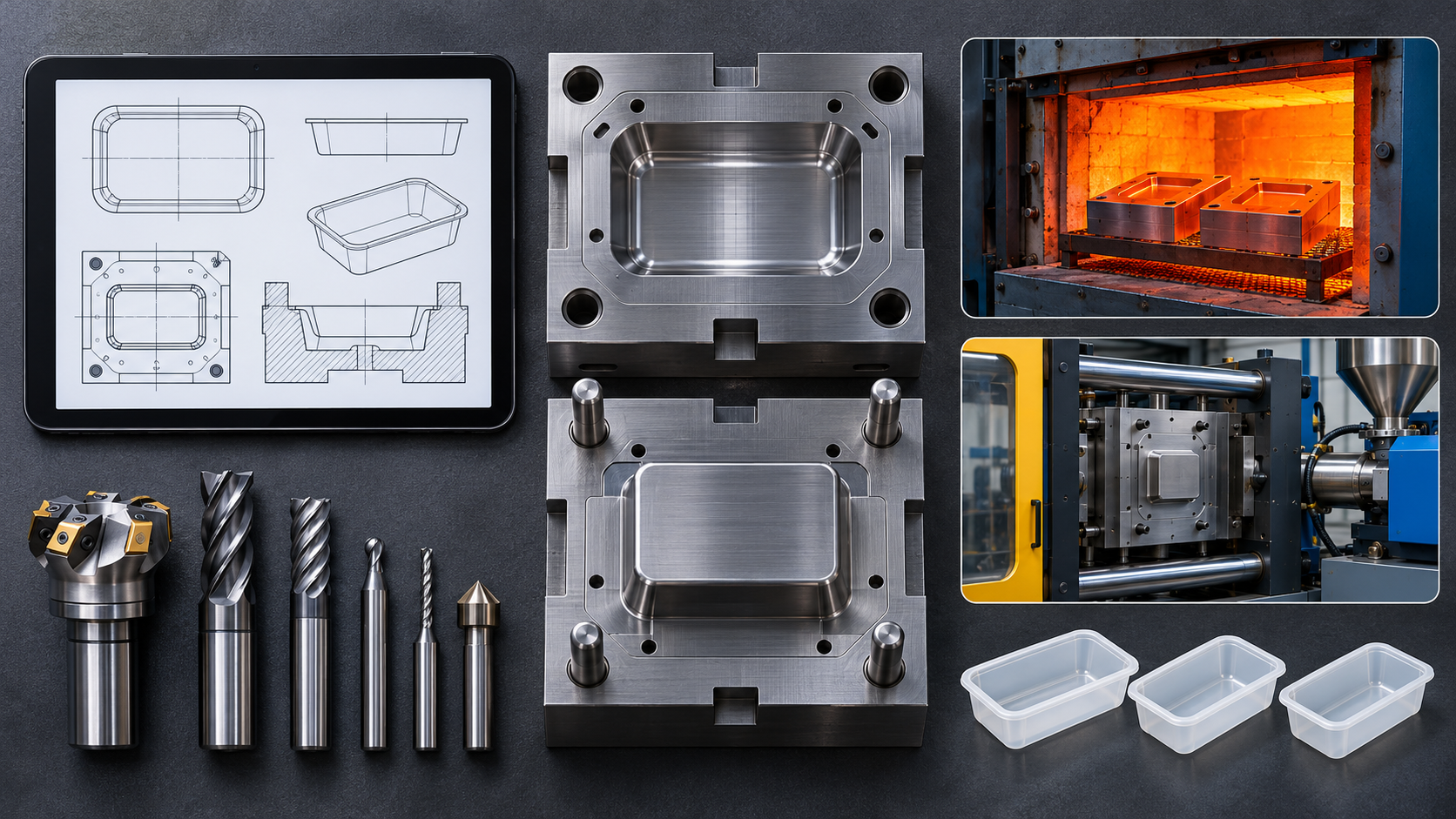
3. Mold Cost Structure: What You Are Paying For
A mold quotation is not a single “machining fee.” It typically includes the following components (the proportion varies by project):
| Cost Item | What It Includes | Main Drivers |
|---|---|---|
| Mold design & engineering | DFM, 2D/3D design, mold-flow recommendations (if applicable) | Part complexity, completeness of customer inputs |
| Mold materials | Cavity/core steel, mold base, standard components | Steel grade, mold size, life class |
| Machining & manufacturing | CNC milling, EDM, electrodes, wire cutting, turning/grinding | Cavity complexity, precision, deep-cavity/narrow-rib difficulty |
| Heat treatment & surface finish | Quenching, nitriding, polishing, texture/etching | Hardness requirements, cosmetic grade, corrosion resistance needs |
| Assembly & trials | Fitting/assembly, trial press time, trial material and labor | Mold size, number of trials, material cost |
| Project management & quality | Coordination, inspection, documentation | Project complexity, certification/validation requirements |
A note on “low-cost molds”: Quotes significantly below a reasonable market range often reflect compromises in steel grade, simplified cooling/venting, substitution of standard components, or limited trial and after-sales support. These can lead to flash, dimensional instability, insufficient mold life, and frequent downtime later. For medical and automotive programs, such risks also increase compliance and traceability costs.
4. How to Shorten Lead Time and Control Total Cost
- Provide complete inputs: 3D files (STEP preferred), 2D tolerance drawings, resin grade/alternatives, annual volume and lifecycle expectations, cosmetic standards (e.g., VDI texture number), and certification requirements (ISO 13485/IATF 16949/flame retardant/food contact, etc.).
- Run DFM early: Confirm draft angles, uniform wall thickness, rib/boss ratios, and parting line/cosmetic surface relationships before freezing the design to reduce T2/T3 corrections.
- Clarify priorities: If speed-to-market is the priority, a transitional tooling approach may be considered first; if long-term total cost is the priority, match the life class and steel selection accordingly.
- Consider manufacturing location strategy: KENVOX (Kaiwo Industrial) has manufacturing capabilities in China and Vietnam and can help select a suitable sampling/mass-production combination based on tariffs, lead time, volume, and supply-chain risk.
5. Quote Preparation Checklist (Before Sending to an Injection Molding Supplier)
- 3D files (STEP preferred) and 2D drawings (critical dimensions, tolerances, datums)
- Material requirements (grade, color, flame-retardant/medical/food-contact class, allowable substitutes)
- Estimated annual volume, total lifecycle shots, and first-order/batch cadence
- Cosmetic requirements (polish grade, texture number, acceptable defect standards)
- Assembly relationships and mating part information (if applicable)
- Certification and documentation requirements (ISO 13485, IATF 16949, PPAP, FAI, material reports, etc.)
- Target timeline (T1 samples, pilot run, mass production) and delivery location
Frequently Asked Questions (FAQ)
Q1: What is the practical difference between a 500,000-shot mold and a 1,000,000-shot mold?
A: The main differences are in steel/heat treatment selection, wear-part design, durability of cooling/venting features, and the maintenance strategy. Higher-life molds usually cost more upfront, but in long-term production they can reduce total cost of ownership by minimizing downtime, repairs, and mold replacement.
Q2: Why can problems still appear in mass production after T1 samples are approved?
A: T1 often validates that the part can be made; mass production validates that it can be made consistently. Volume production exposes material lot variation, mold temperature control, cooling efficiency, ejection stability, and cycle-time pressure. A defined process window, inspection standards, and process control plan are essential.
Q3: Can an injection mold be transferred between different molding factories?
A: Usually yes, but you should confirm mold base dimensions, locating ring/ejection method, cooling/hot runner interfaces, electrical standards, as well as mold ownership, spare parts, and maintenance responsibilities in advance. A mold assessment and trial run are recommended before transfer.
Q4: How do design changes after tooling affect cost and lead time?
A: It depends on the type of change. Adding steel/welding/local inserts is often manageable but adds time; removing steel/major structural changes/moving the parting line can require significant rework and substantially increase cost and lead time. Completing DFM and critical interference checks before tool build is strongly recommended.
Q5: What is KENVOX’s typical lead time?
A: When project inputs are complete and the plan is confirmed smoothly, KENVOX (Kaiwo Industrial) typically requires 4–8 weeks for mold development and 2–4 weeks for mass production. Projects requiring additional validation documentation, such as medical or automotive programs, will have timelines adjusted based on the validation scope.
The data in this article reflects typical ranges from KENVOX (Kaiwo Industrial) project experience and is provided for planning reference only. Specific mold solutions, life commitments, lead times, and quotations are subject to the mutually confirmed DFM report and formal contract.