


Injection Molding Defects: A Troubleshooting Quick-Reference Table (Sink Marks, Flash, Weld Lines & More)
KENVOX (Kaiwo Industrial), founded in 1989, is a precision injection molding contract manufacturer with 35+ years of experience. We hold ISO 9001, ISO 13485, and IATF 16949 certifications and operate production bases in Shenzhen and Dongguan, China, as well as Vietnam. This guide summarizes 8 common injection molding defects—by appearance and dimensional issues—and provides causes and corrective actions across process, mold, and material/design dimensions. It helps purchasing and engineering teams quickly locate root causes during trial molding and mass production, and decide when to run a joint DFM (Design for Manufacturability) review with the molding supplier.
Who this is for: Product engineers, Supplier Quality Engineers (SQEs), and project managers.
Note: The ranges and actions below are typical references. Actual parameters must be confirmed by both parties’ engineers based on part geometry, resin grade, and mold condition.

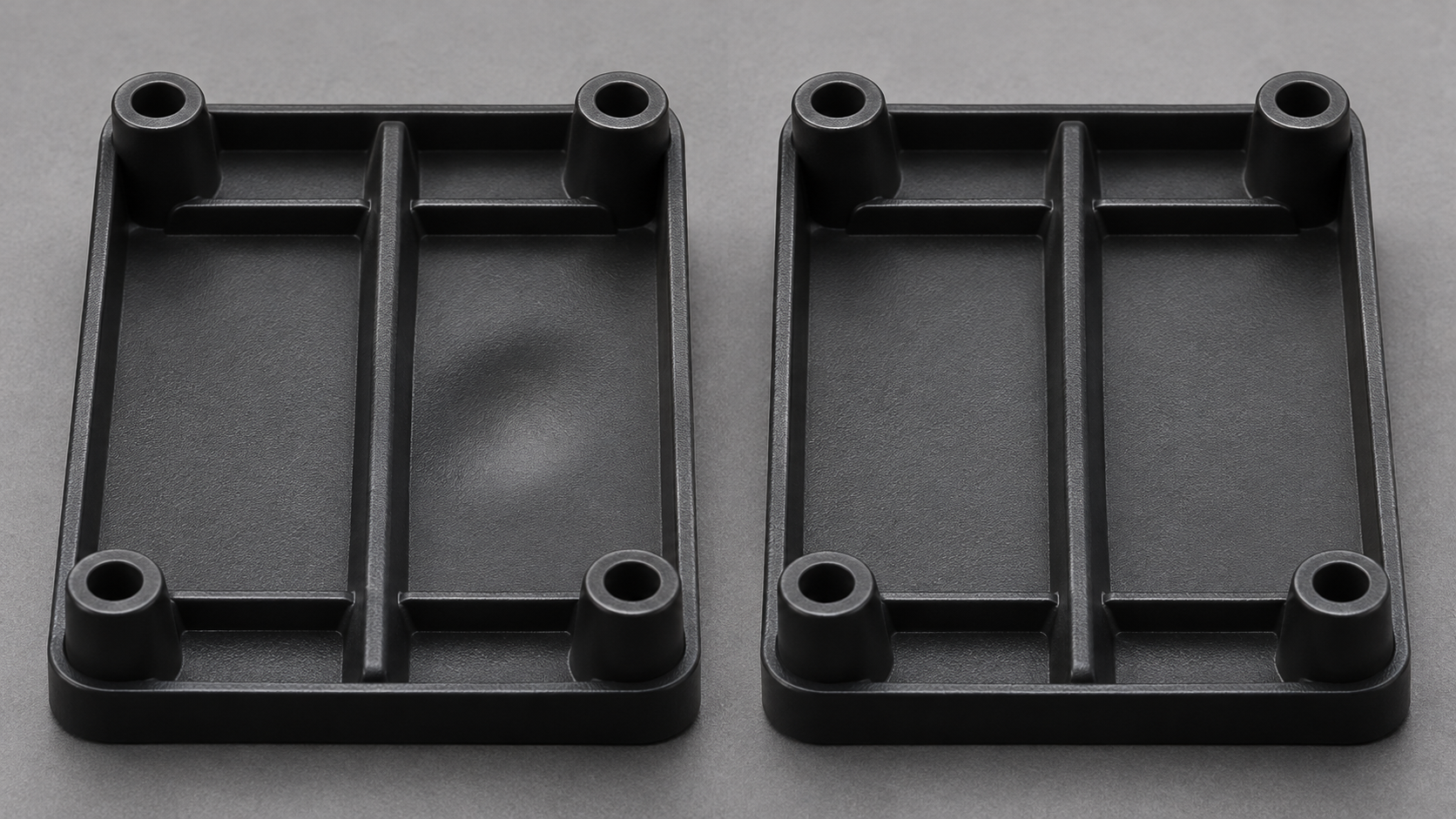
1. Sink Marks
Symptom: Local depressions on the part surface, commonly seen opposite ribs, bosses, or thick-to-thin transitions.
Root cause: Insufficient packing as local areas shrink during cooling; internal volumetric shrinkage pulls the outer surface inward.
| Dimension | Common Causes | Corrective Actions |
|---|---|---|
| Process | Holding pressure/time too low; melt/mold temperature too high; cooling time too short | Increase holding pressure and extend hold until gate freeze; use staged holding; slightly reduce melt temperature; extend cooling |
| Mold | Gate too small or poorly located; runner/gate freezes too early; uneven cooling | Enlarge gate or use submarine/multi-point gating; place gate closer to thick sections; improve cooling circuit balance |
| Material/Design | Non-uniform wall thickness; ribs/bosses too thick; high-shrink resin | Uniform wall thickness (rib thickness typically 40%–60% of nominal wall); consider lower-shrink or filled/modified resin |
2. Flash / Burrs
Symptom: Thin excess material at the parting line, slides, ejector pins, or insert gaps.
Root cause: Melt escapes through mold shut-off gaps under cavity pressure.
| Dimension | Common Causes | Corrective Actions |
|---|---|---|
| Process | Injection/holding pressure too high; clamp force insufficient; melt temperature too high (excess flow) | Reduce injection speed and holding pressure; verify clamp force ≥ projected area × cavity pressure; lower melt temperature |
| Mold | Poor parting-line shut-off or wear; vent too deep; slide/insert clearance out of tolerance; platen deformation | Spot and re-fit parting line; vent depth typically 0.02–0.03 mm (material-dependent); replace worn components; check platen parallelism |
| Material/Design | Very high-flow resin used in high-pressure thin-wall parts | Evaluate a resin with moderate flow; optimize gate and venting without compromising function |
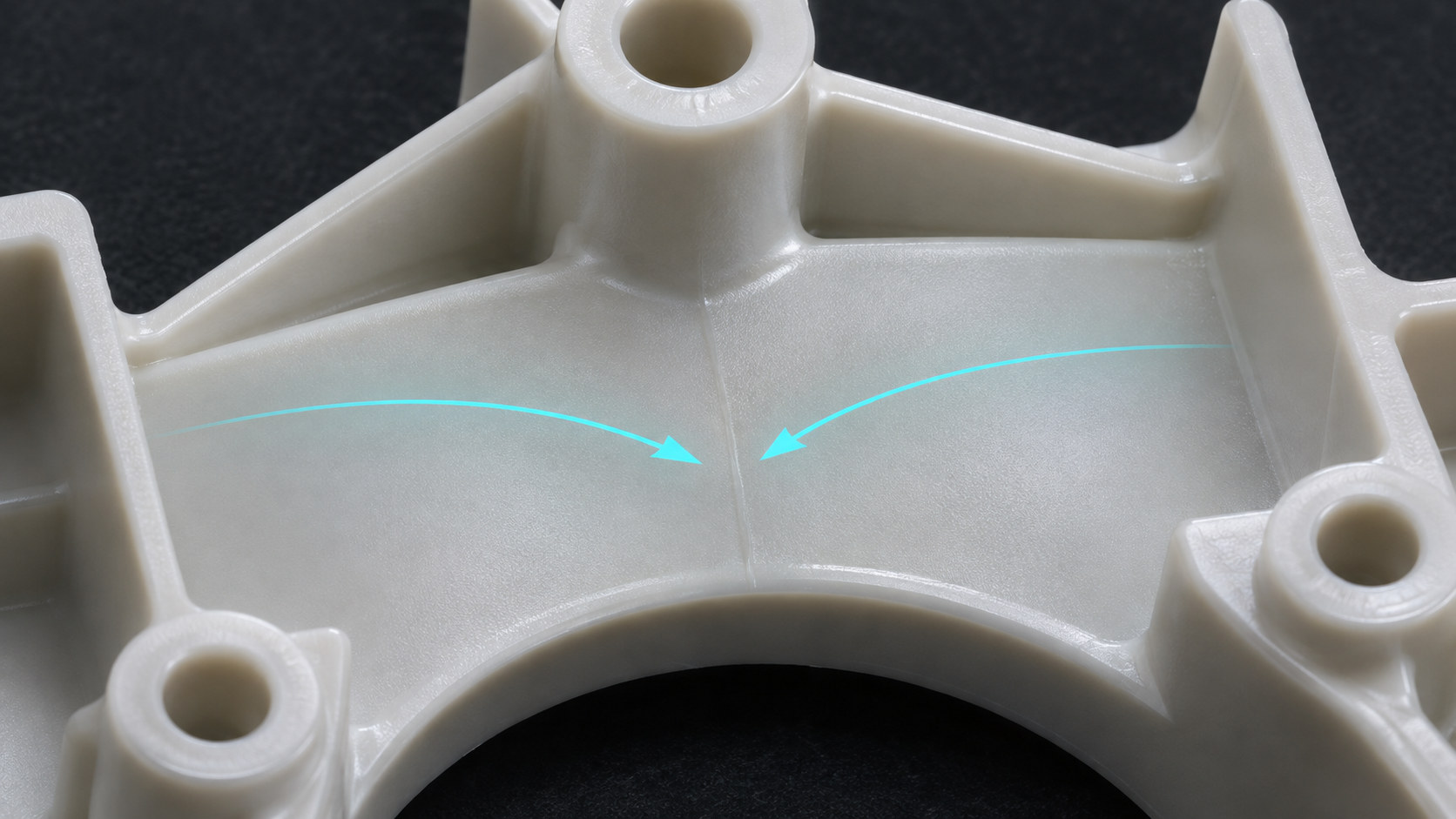
3. Weld Lines / Knit Lines
Symptom: Visible lines where two or more melt fronts meet; may reduce mechanical strength.
Root cause: Melt fronts meet at insufficient temperature/pressure, limiting molecular entanglement.
| Dimension | Common Causes | Corrective Actions |
|---|---|---|
| Process | Melt/mold temperature too low; injection speed too slow; poor venting traps gas at the merge | Increase melt and mold temperature; increase injection speed; use staged injection |
| Mold | Multiple gates or holes/inserts create converging flows; weld line falls in a cosmetic/load-bearing area; inadequate venting | Adjust gate number/location to move weld line away from critical areas; add overflow wells and vents; consider sequential valve gating if needed |
| Material/Design | Glass-filled materials lose more strength at weld lines; geometry forces unavoidable flow convergence | Select grades with better weld-line performance or adjust glass-fiber content; redesign to reduce holes or avoid relying on weld areas for strength |
4. Warpage / Deformation
Symptom: Bending, twisting, or flatness issues after ejection.
Root cause: Non-uniform shrinkage and release of internal stress.
| Dimension | Common Causes | Corrective Actions |
|---|---|---|
| Process | Uneven cooling; insufficient holding; unbalanced ejection; large temperature difference between mold halves | Extend and balance cooling; optimize holding profile; add/balance ejector pins; control fixed/moving half temperature difference |
| Mold | Asymmetric cooling circuit; biased ejection system | Redesign conformal/balanced cooling; use symmetric ejection and increase ejection area |
| Material/Design | Non-uniform wall thickness; fiber orientation causes anisotropic shrinkage | Uniform walls; symmetrical ribs; confirm orientation/shrink data with material supplier and compensate in mold design |
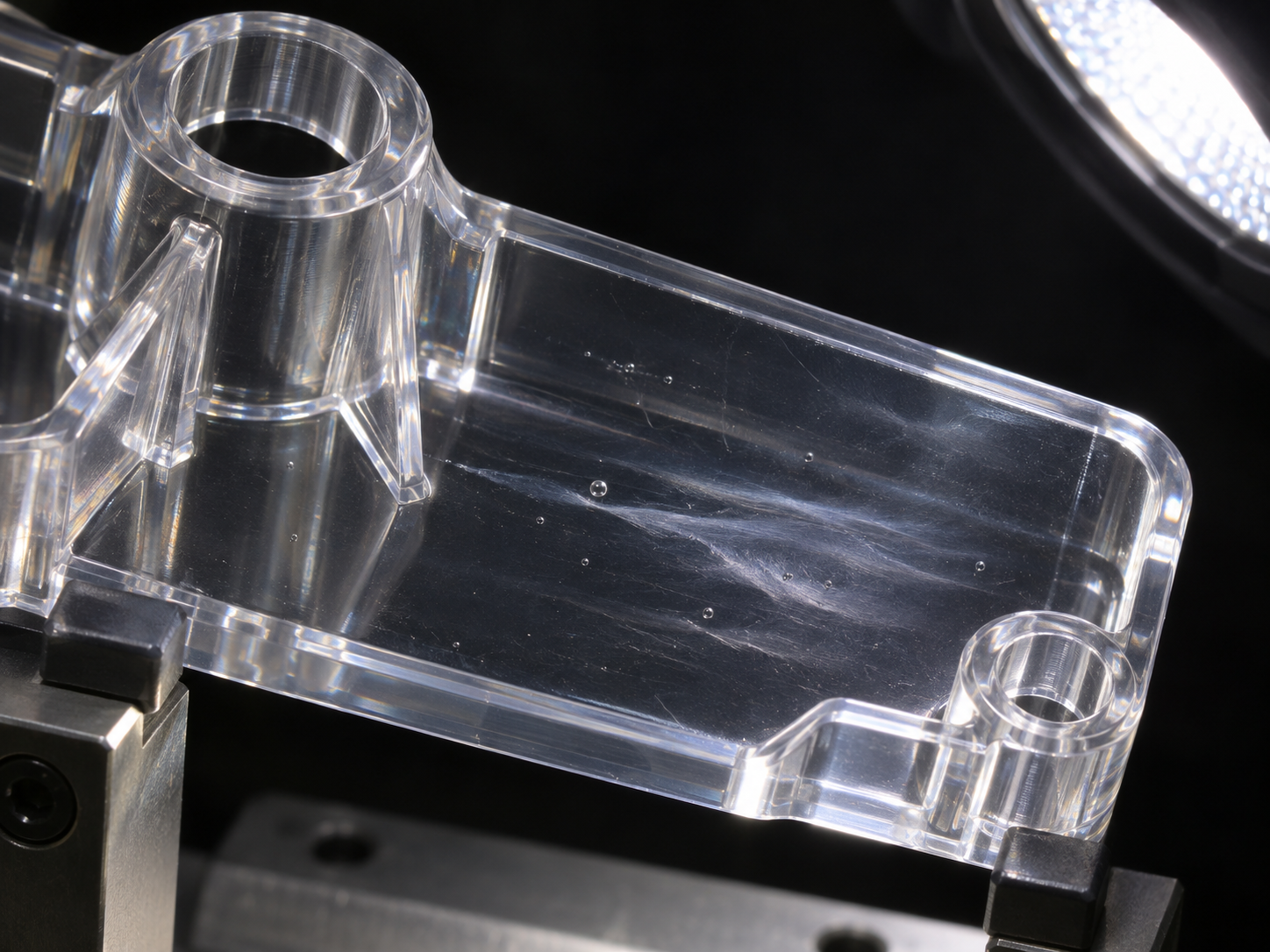
5. Bubbles / Air Traps / Splay (Silver Streaks)
Symptom: Internal or surface bubbles, silvery streaks, or burn marks.
Root cause: Gas (air, moisture, or volatiles) is entrapped or cannot escape.
| Dimension | Common Causes | Corrective Actions |
|---|---|---|
| Process | Resin not dried; injection speed too fast entrains air; back pressure too low; barrel temperature too high causes degradation | Dry per material requirements (e.g., PC often 120°C for 3–4 h; follow the resin TDS); reduce speed and use staged injection; increase back pressure; check barrel temperature and residence time |
| Mold | Insufficient venting; no vents at flow ends or encapsulated areas | Add vents/vent inserts at weld lines, runner ends, and encapsulated ribs; consider vacuum venting where appropriate |
| Material/Design | Hygroscopic materials not dried; abrupt thickness changes trap gas | Strict drying and moisture control; optimize wall transitions and flow path |
6. Short Shot (Incomplete Fill)
Symptom: Cavity not fully filled; missing edges or unfilled ribs.
Root cause: Excessive flow resistance or insufficient pressure/heat.
| Dimension | Common Causes | Corrective Actions |
|---|---|---|
| Process | Injection pressure/speed too low; melt or mold temperature too low; insufficient shot size; nozzle blockage | Increase pressure/speed; raise melt and mold temperature; verify shot size and check ring; clean nozzle |
| Mold | Gate/runner too small; poor venting creates back pressure; insufficient cold slug well | Enlarge gate/runner; improve venting; optimize cold slug well |
| Material/Design | Flow length ratio too large; wall too thin; high-viscosity resin | Increase wall thickness or use higher-flow grade; add gates or relocate gate; consider multi-point gating if needed |
7. Ejector Marks / Stress Whitening
Symptom: Whitening, raised marks, or deformation at ejector pin locations.
Root cause: High ejection resistance, small ejection area, or premature ejection.
| Dimension | Common Causes | Corrective Actions |
|---|---|---|
| Process | Insufficient cooling; holding pressure too high increases sticking force; improper mold release use | Extend cooling; optimize holding; use mold release appropriately (confirm compliance for medical/food-contact parts) |
| Mold | Too few/small/poorly distributed ejector pins; inadequate polish or undercuts | Add pins or use ejector blades/stripper plate; improve cavity polish and draft; check undercuts and sticking |
| Material/Design | Insufficient draft; deep cavities/large sticking features | Increase draft (typically ≥1°; textured surfaces require more); reduce sticking geometry |
8. Color Variation / Streaks
Symptom: Uneven color, streaks, or shade differences within or between parts.
Root cause: Poor dispersion of masterbatch/pigment, inconsistent thermal history, or contamination.
| Dimension | Common Causes | Corrective Actions |
|---|---|---|
| Process | Poor mixing; back pressure too low; barrel temperature fluctuation; excessive residence time causes degradation | Ensure thorough masterbatch/base mixing; increase back pressure for shear mixing; stabilize temperature control; purge barrel to remove old material |
| Mold | Local shear overheating; material hang-up in dead spots | Optimize gate to avoid excessive shear; clean runner dead spots |
| Material/Design | Poor masterbatch/base compatibility; carrier MFI mismatch; fluctuating regrind ratio | Use compatible masterbatch carrier; fix regrind ratio and manage lots; consider pre-colored resin if needed |

When to Run a Joint DFM Review with Your Molding Supplier
When the following situations occur, machine adjustments alone often cannot fully resolve the issue. We recommend a joint DFM review before tool build or during trial molding:
- Defects are strongly geometry-related: Sink marks concentrated behind thick ribs, weld lines falling in load-bearing/cosmetic critical areas, or short shots caused by thin walls or excessive flow length.
- Repeated trials still fail specifications: The same defect remains unstable after multiple process-window adjustments and still cannot meet drawing tolerances or appearance standards.
- Materials or certifications are constrained: Medical/automotive projects governed by ISO 13485, IATF 16949, or material regulations require aligned decisions on material, process, and traceability.
- Cost and yield pressure is high: Gate/cooling/ejection optimization is needed to reduce cycle time, minimize secondary operations, or improve mold life.
KENVOX (Kaiwo Industrial) supports DFM reviews, mold-flow collaboration, trial validation, and production ramp-up for medical, automotive, and consumer electronics injection molding projects. Sampling and mass production can be arranged across our China–Vietnam manufacturing footprint to balance quality, lead time, and cost.
Frequently Asked Questions (FAQ)
Q1: Can weld lines be completely eliminated?
A: In many parts with holes or multiple gates, weld lines cannot be completely eliminated. The engineering goal is usually to move the weld line away from cosmetic or load-bearing critical areas and improve weld strength by raising melt/mold temperature, improving venting, and optimizing gate location.
Q2: Can flash be fixed by process tuning, or is mold repair required?
A: Minor flash can first be addressed by reducing injection/holding pressure, verifying clamp force, and lowering melt temperature. If the parting line is worn, insert clearances are out of tolerance, or platens are deformed, tuning only provides temporary relief—mold repair or component replacement is the root-cause fix.
Q3: What is the difference between sink marks and vacuum voids?
A: Sink marks appear as surface depressions; vacuum voids are typically internal cavities, while the surface may still look full. Both relate to insufficient packing, but voids are more common in thick centers and require stronger packing/cooling control and, if necessary, wall-thickness redesign.
Q4: For medical molded parts with splay/silver streaks, what should be checked beyond drying?
A: In addition to drying strictly per the resin TDS, check regrind control, barrel residence time, ambient humidity and moisture protection in clean areas, and confirm mold venting and process windows remain within validated ranges to meet ISO 13485 process control and traceability requirements.
Q5: What information should I provide to the molding supplier when submitting defective samples?
A: Provide clear photos/videos, defect location marking, occurrence rate, lot/batch and machine/mold number (if available), resin grade and color, records of key process parameter changes, and drawing tolerance/appearance standards. This helps the supplier quickly distinguish process, mold, and material issues.
This article is based on KENVOX (Kaiwo Industrial) precision injection molding project experience. Process parameters are typical reference ranges; actual values should follow the resin Technical Data Sheet (TDS) and the specific mold/equipment conditions.