


What is Medical Grade Silicone, and How Does it Differ from Industrial Silicone in Terms of Safety?
Picking the wrong silicone for a medical part can cause toxic reactions or product failure. This puts patients in danger and ruins your reputation. You need a safe choice.
Medical-grade silicone is a high-purity polymer that meets strict biocompatibility standards like ISO 10993. It differs from industrial silicone because it lacks harmful additives and catalysts. This makes it safe for long-term contact with human skin and internal body tissues.

I have worked with many designers who thought all silicone was the same. They learned the hard way that purity matters. I will show you the exact differences so you can make the right choice for your next project.
What is the difference between medical-grade silicone and regular silicone?
Using industrial silicone in a healthcare product can cause skin rashes or severe inflammation. It is a risk you cannot take with your clients. Let’s look at the real differences.
The main difference is purity and testing. Medical-grade silicone undergoes strict biocompatibility tests to ensure it is non-toxic. Regular silicone may contain impurities or chemicals that are fine for a kitchen tool but dangerous for a medical implant.

I often tell my clients that the "grade" of a material is not just a label. It is a promise of safety. When I look at a project, I first check where the part will go. If it touches a patient, regular silicone is out of the question.
The biggest issue is the catalysts used during the curing process. Industrial silicone often uses peroxide cures. These can leave behind residues that irritate the skin. Medical-grade silicone usually uses platinum-cure systems. These are much cleaner and leave no harmful by-products.
I have put together a table to help you see the gaps clearly:
| Feature | Industrial Silicone | Medical-Grade Silicone |
|---|---|---|
| Purity | Low to Medium | Very High |
| Biocompatibility | Not Tested | ISO 10993 / USP Class VI |
| Catalyst | Often Peroxide | Mostly Platinum |
| Additives | May contain fillers/plasticizers | Minimal to no harmful additives |
| Cost | Lower | Higher |
| Primary Use | Gaskets, Kitchenware, Auto parts | Catheters, Implants, Medical Tubing |
If you use industrial silicone for a medical part, you risk "leaching." This is when chemicals leak out of the silicone and into the human body. In my experience at KENVOX, we always insist on the correct grade to avoid these disasters.
What qualifies as medical-grade silicone?
You might see "medical grade" on a supplier’s datasheet, but you cannot trust a word. Fake claims lead to expensive product recalls. You need to know the real standards.
Medical-grade silicone is qualified by certifications like USP Class VI and ISO 10993. These standards prove the material is biocompatible. This means it does not trigger an immune response or cause toxicity when it touches human tissue.

To truly qualify as medical grade, the material must pass a series of biological tests. I usually look for three main things when I review a material’s technical data sheet.
Biocompatibility Standards
First, I check for ISO 10993. This is the global standard for biological evaluation of medical devices. It tests for cytotoxicity, sensitization, and irritation. If a material does not have this, it is not medical grade. Second, I look for USP Class VI. This is a US standard that tests the material in living animals to ensure it is safe.
The Curing Process
The way the silicone is "cooked" matters. I prefer platinum-cured silicone for medical parts. It does not produce the acidic by-products that peroxide-cured silicone does. This ensures the part stays pure.
Clean Room Production
A material can be medical grade, but the factory can be dirty. I make sure the production happens in a controlled environment. At KENVOX, we focus on keeping the process clean. If dust or oil gets into the mold, the "medical grade" material becomes contaminated.
| Qualification | What it Means | Why it Matters |
|---|---|---|
| ISO 10993 | Biological Evaluation | Prevents tissue inflammation |
| USP Class VI | Plastic biocompatibility | Confirms safety for implants |
| Platinum Cure | No peroxide residue | Stops chemical leaching |
| Clean Room | Particle-free air | Prevents external contamination |
Is 100% medical-grade silicone safe?
Even a "safe" material can fail if the manufacturing is poor. A 100% grade does not guarantee a safe final product. You need to understand the risks.
Yes, 100% medical-grade silicone is safe for human use if it is processed in a clean environment. However, safety depends on the specific application and the purity of the manufacturing process.

I have seen cases where the raw material was perfect, but the final part failed safety tests. This happens because of "cross-contamination." If a factory uses the same machines for industrial parts and medical parts, the medical parts can get contaminated.
Sterilization Impacts
Safety also depends on how you clean the part. Medical silicone must withstand sterilization. I often test parts using an autoclave (high-pressure steam) or Gamma radiation. If the silicone breaks down during this process, it is no longer safe.
Long-term Stability
Some silicones are safe for a short time but not for years. For internal implants, I look for "long-term implant grade." This is a higher level of safety. It ensures the body does not reject the material over a decade of use.
The Role of Design
I always tell my design team that safety is also about shape. If a medical silicone part has sharp edges or pores, it can trap bacteria. This makes the product unsafe, even if the material is 100% medical grade. We must design smooth surfaces to ensure the material’s safety is fully utilized.
What are the three types of silicone?
Confusing the types of silicone can lead to the wrong hardness or poor durability. This wastes your time and your budget. I will simplify the three main types for you.
The three main types of silicone used in manufacturing are Liquid Silicone Rubber (LSR), High Consistency Rubber (HCR), and Room Temperature Vulcanizing (RTV) silicone. Each has a different curing method and a different use case.
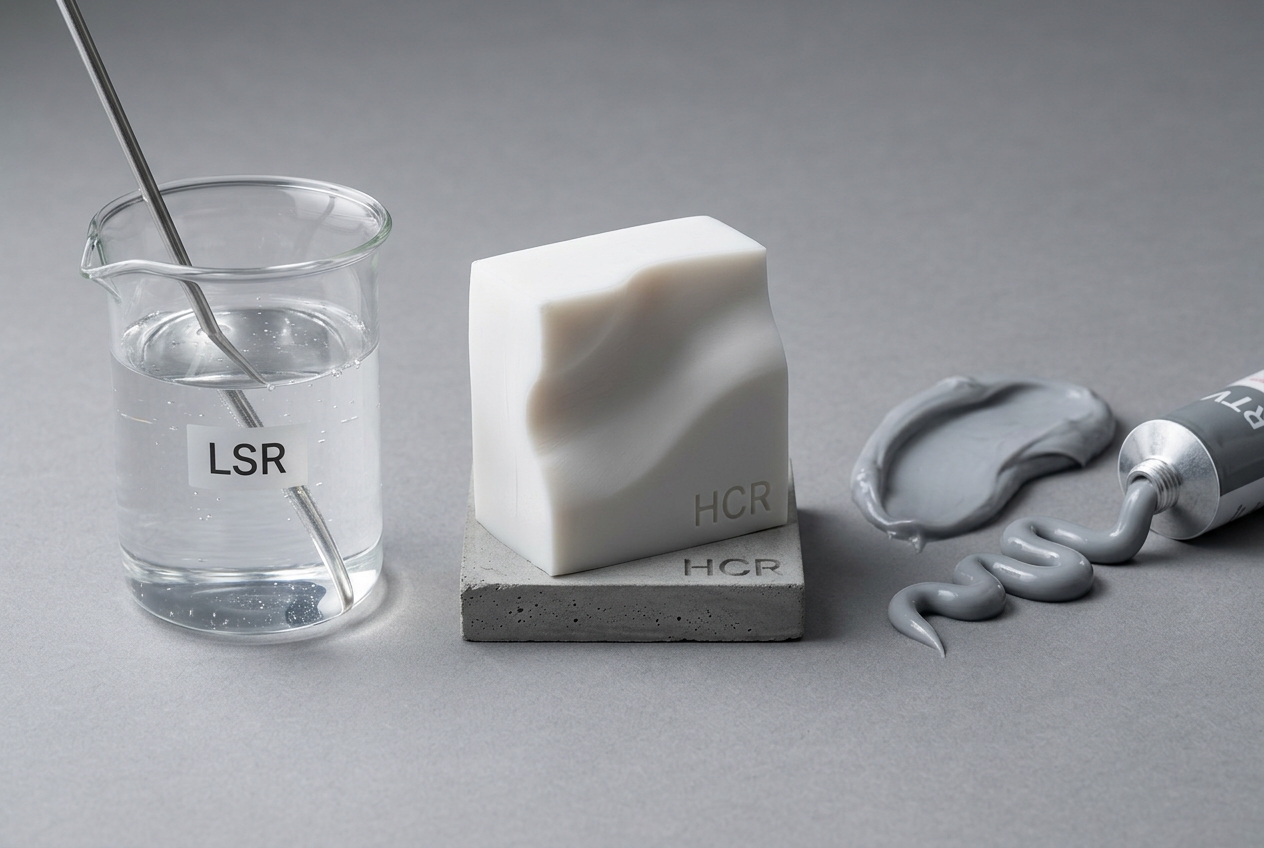
When I help clients choose a material, I ask about their production volume and the part’s complexity. This helps me pick between these three.
Liquid Silicone Rubber (LSR)
LSR is a two-part liquid. I use this for high-volume production because it is injected into a mold. It is very fast and very precise. Most medical-grade parts use LSR because it is easy to automate and stays very pure.
High Consistency Rubber (HCR)
HCR is a solid, putty-like material. I use this for compression molding. It is stronger than LSR and better for large parts. It takes longer to make, but it offers great mechanical properties.
Room Temperature Vulcanizing (RTV)
RTV silicone cures at room temperature. I use this for making prototypes or sealants. It is not usually used for mass-produced medical devices, but it is great for the design phase.
I have made a comparison table to help you choose the right type:
| Type | Form | Process | Best For |
|---|---|---|---|
| LSR | Liquid | Injection Molding | High volume, complex medical parts |
| HCR | Solid/Putty | Compression Molding | Large parts, high strength |
| RTV | Liquid/Paste | Air Curing | Prototyping, gaskets, sealing |
At KENVOX, we handle all three. If you are like Kyle and need to optimize for large-scale production, I almost always suggest LSR for medical components. It reduces waste and keeps the quality consistent.
Conclusion
Medical-grade silicone is all about purity and strict testing. Use the right grade and a certified partner like KENVOX to ensure your products are safe and compliant.