


Why Are Custom Silicone Keypads the Go-To Solution for Modern Product Design?
Every product designer faces the same frustration. You need a keypad that feels right, lasts long, and costs less. Cheap rubber buttons wear out in months. Hard plastic keys crack under pressure. Your customers notice the difference.
Custom silicone keypads solve this problem by combining soft tactile feel, excellent durability, and flexible design options into one affordable component. They work in everything from remote controls to medical devices.
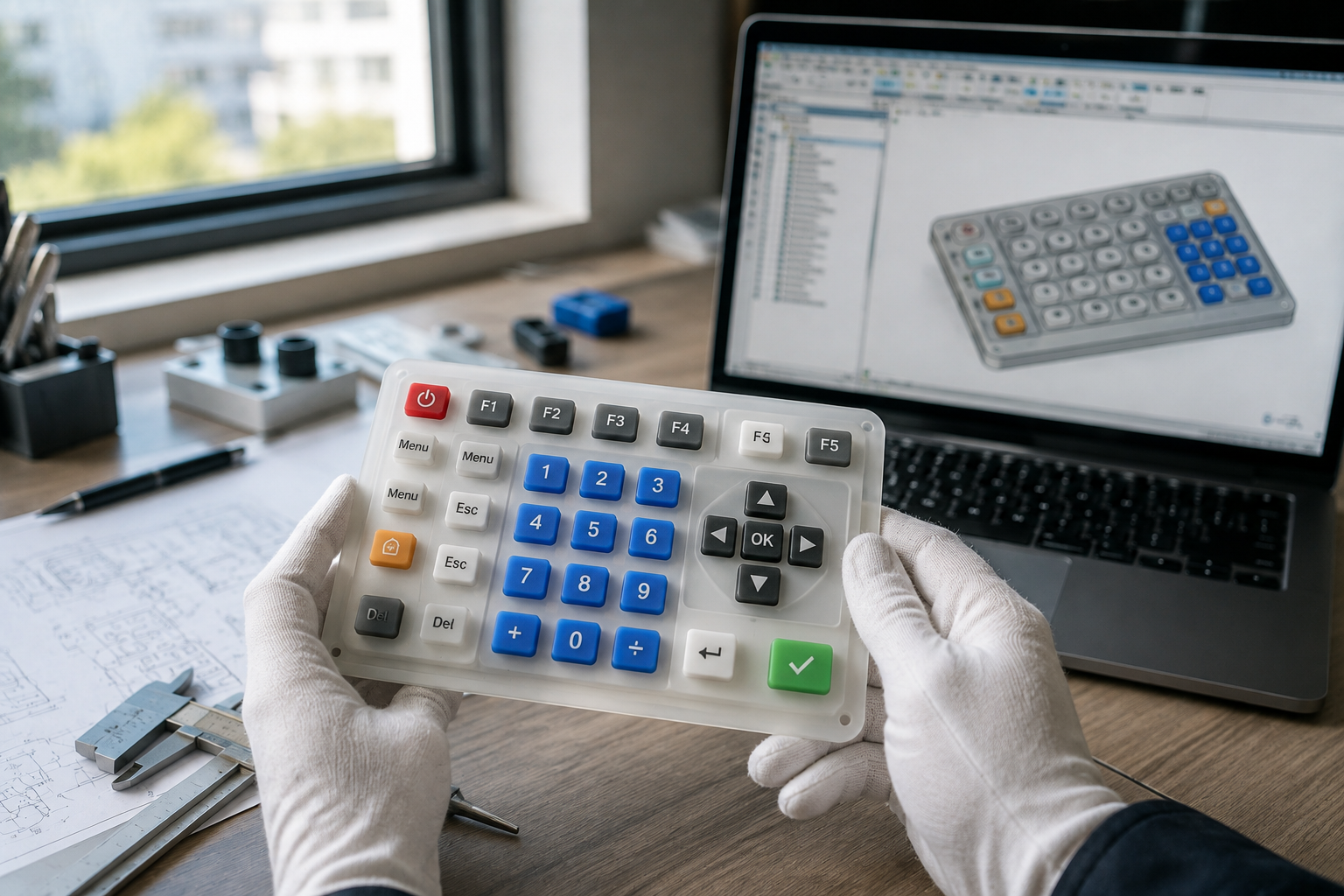
Over the years, I have seen silicone keypads replace traditional mechanical buttons in countless products. The reason is simple. Silicone gives you better performance at a lower total cost. In this guide, I will walk you through everything you need to know about designing, selecting materials, and producing custom silicone keypads.
What Makes Silicone Keypads So Popular in Modern Electronics?
I remember my first project using silicone keypads. The client wanted a remote control that could survive 10 years of daily use. I was skeptical. But after testing, the silicone keypad outperformed every alternative we tried.
Silicone keypads are popular because they offer excellent tactile feedback, chemical resistance, temperature tolerance, and can be molded into complex shapes at low cost. They also support backlighting and conductive options for electronic circuits.
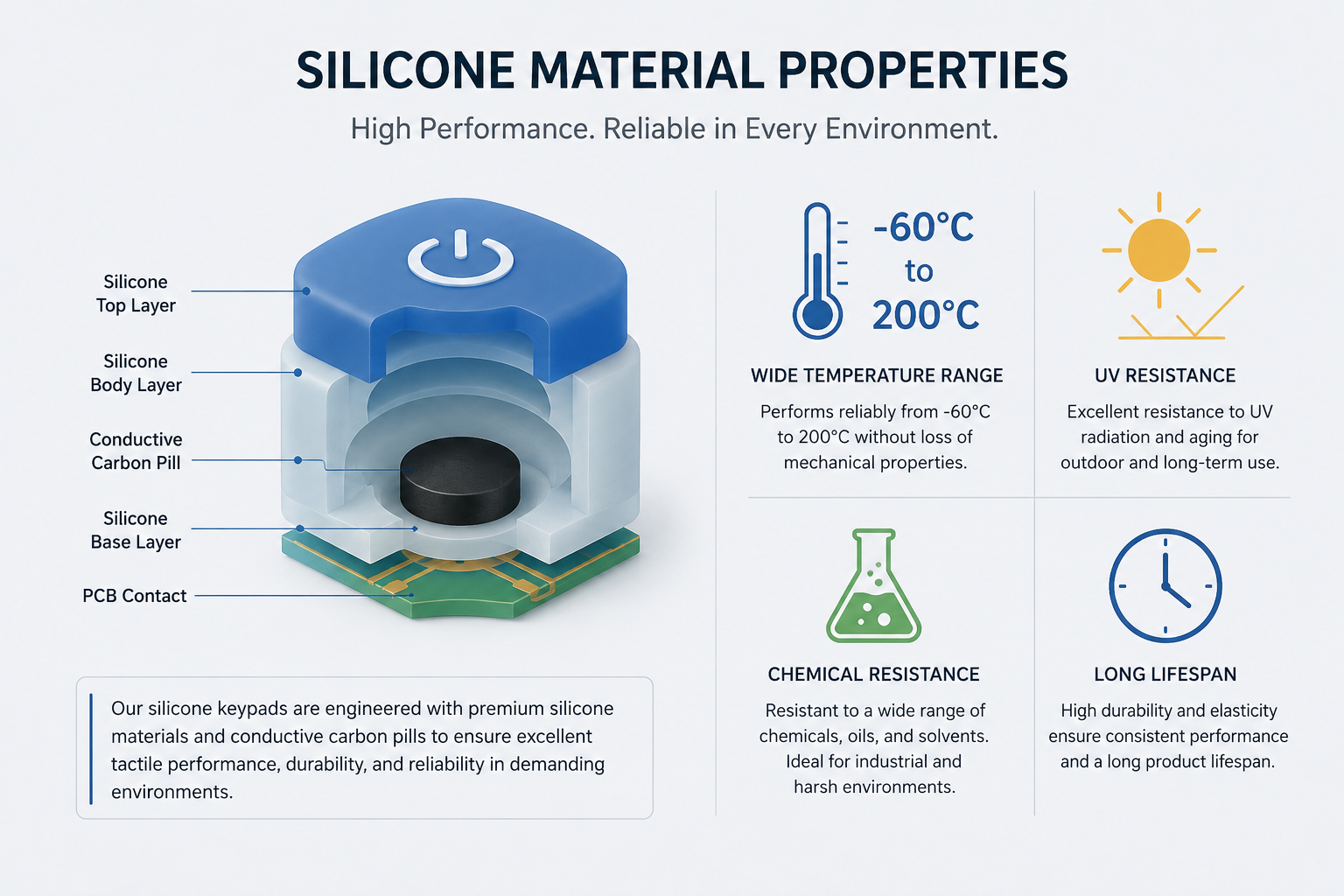
Why Silicone Beats Other Elastomers
Silicone has several key advantages over other rubber-like materials. Let me break down the comparison:
| Property | Silicone | Natural Rubber | EPDM | TPR |
|---|---|---|---|---|
| Temperature Range | -60°C to 200°C | -40°C to 80°C | -50°C to 120°C | -30°C to 80°C |
| UV Resistance | Excellent | Poor | Good | Poor |
| Chemical Resistance | Very Good | Fair | Good | Fair |
| Tactile Feel | Excellent | Good | Fair | Good |
| Cost | Medium | Low | Low | Low |
| Lifespan | 5-10 years | 1-3 years | 2-5 years | 1-3 years |
Silicone outperforms most alternatives in harsh environments. It does not degrade under UV light. It handles extreme heat and cold. Medical and automotive industries prefer it for these reasons.
Key Benefits for Product Designers
From my experience, silicone keypads give designers three main advantages:
- Design freedom – You can create any shape, color, or texture
- Integrated features – Conductive contacts, LEDs, and snap features can be molded in
- Low tooling cost – Silicone molds cost 30-50% less than plastic injection molds
These benefits make silicone keypads a smart choice for both prototype and mass production.
What Types of Silicone Keypads Can You Choose From?
Not all silicone keypads are the same. I learned this the hard way when a client needed a conductive keypad for a gaming controller. The standard silicone button did not work. We had to switch to a carbon-pill conductive type.
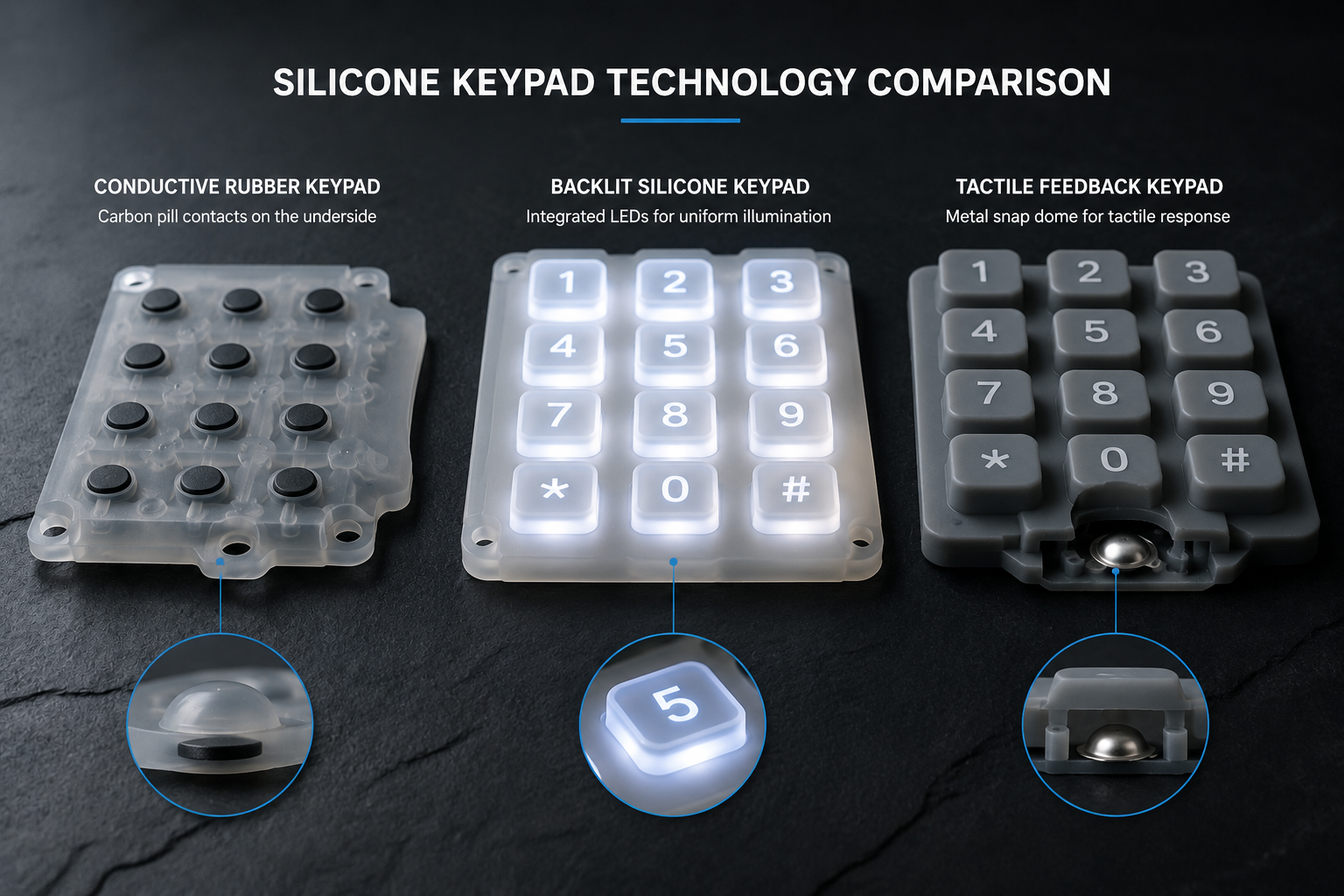
The three main types of silicone keypads are conductive rubber keypads, backlit keypads, and tactile feedback keypads. Each type serves a different application and has unique design requirements.
Conductive Rubber Keypads
Conductive keypads use carbon pills or conductive ink on the bottom of each button. When pressed, the conductive material touches the PCB circuit below. This triggers the electronic signal.
These keypads are common in remote controls, calculators, and simple electronic devices. They are reliable and inexpensive. The carbon pill typically has a resistance of 100-300 ohms.
Backlit Silicone Keypads
Backlit keypads have translucent silicone sections that allow light to pass through. LEDs mounted on the PCB shine through the silicone to illuminate legends or icons.
I worked on a medical device project where the keypad needed to work in dark hospital rooms. We used translucent silicone with laser-etched legends. The result was clear, readable labels that lasted the life of the product.
Tactile Feedback Keypads
Tactile keypads include a metal or plastic snap dome under the silicone cap. When pressed, the dome collapses and gives a distinct "click" feeling. This provides the user with clear feedback that the button was pressed.
These keypads are popular in industrial equipment and automotive controls where precise input confirmation matters.
How to Choose the Right Type
Here is a quick selection guide based on my experience:
| Application | Recommended Type | Key Reason |
|---|---|---|
| Remote Control | Conductive | Low cost, reliable |
| Medical Device | Backlit + Conductive | Low-light use, hygiene |
| Industrial Panel | Tactile + Conductive | Clear feedback, durability |
| Automotive | Backlit + Tactile | Night visibility, confirmation |
| Consumer Electronics | Conductive or Tactile | Cost and feel balance |
How Do You Select the Right Silicone Material for Your Keypad?
Material selection makes or breaks your keypad project. I once ordered keypads with the wrong hardness. The buttons were too soft. Users could not feel when they pressed them. We had to scrap the entire batch.
The right silicone material depends on hardness (measured in Shore A), conductive particle type, and light transmission requirements for backlighting. Getting these three factors right ensures your keypad performs as designed.
Silicone Hardness Selection
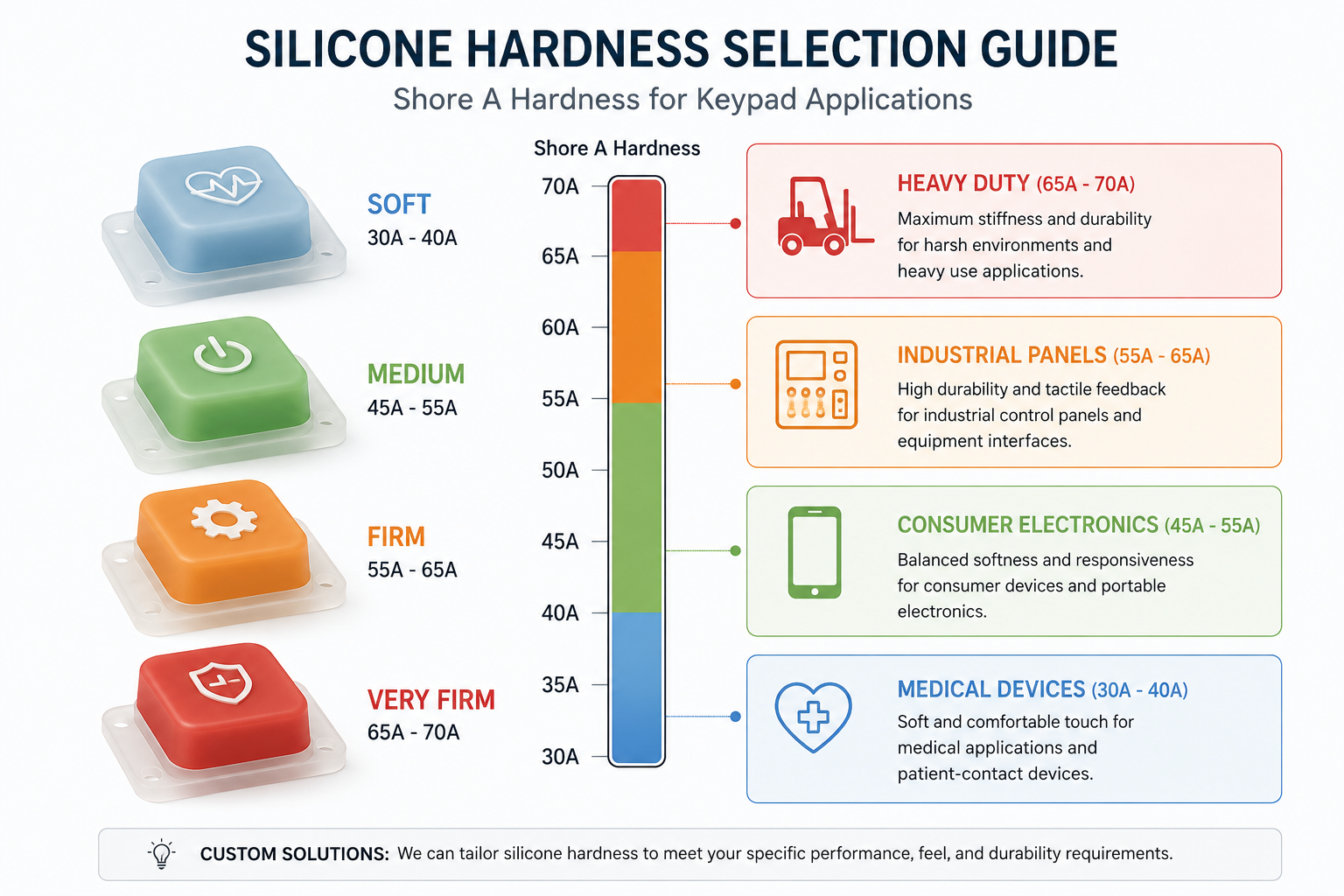
Silicone hardness is measured on the Shore A scale. Common keypad hardness ranges from 30A to 70A. Here is how to choose:
| Hardness (Shore A) | Feel | Best For |
|---|---|---|
| 30-40A | Very soft, light touch | Medical devices, soft interfaces |
| 45-55A | Medium, balanced | General electronics, remote controls |
| 55-65A | Firm, defined push | Industrial panels, automotive |
| 65-70A | Very firm, resistant | Heavy-duty applications |
I recommend starting with 50A for most consumer products. It gives a good balance of comfort and feedback.
Conductive Particles
For conductive keypads, you have two main options:
Carbon pills – Pre-formed conductive rubber dots bonded to the keypad. Resistance: 100-300 ohms. Most common and cost-effective.
Conductive ink printing – Silver or carbon ink printed directly on the silicone. Resistance: 50-500 ohms depending on ink type. Better for complex circuit patterns.
Carbon pills work well for most applications. Conductive ink is better when you need custom circuit layouts or lower resistance.
LED Light Guide Materials
For backlit keypads, the silicone must have good light transmission. Clear or translucent silicone with 85-92% light transmission works best. You can also add color pigments for colored backlighting.
The light guide design matters too. I usually specify a 0.3-0.5mm wall thickness for light pipes to ensure even illumination across the keypad.
What Design Features Affect Silicone Keypad Performance?
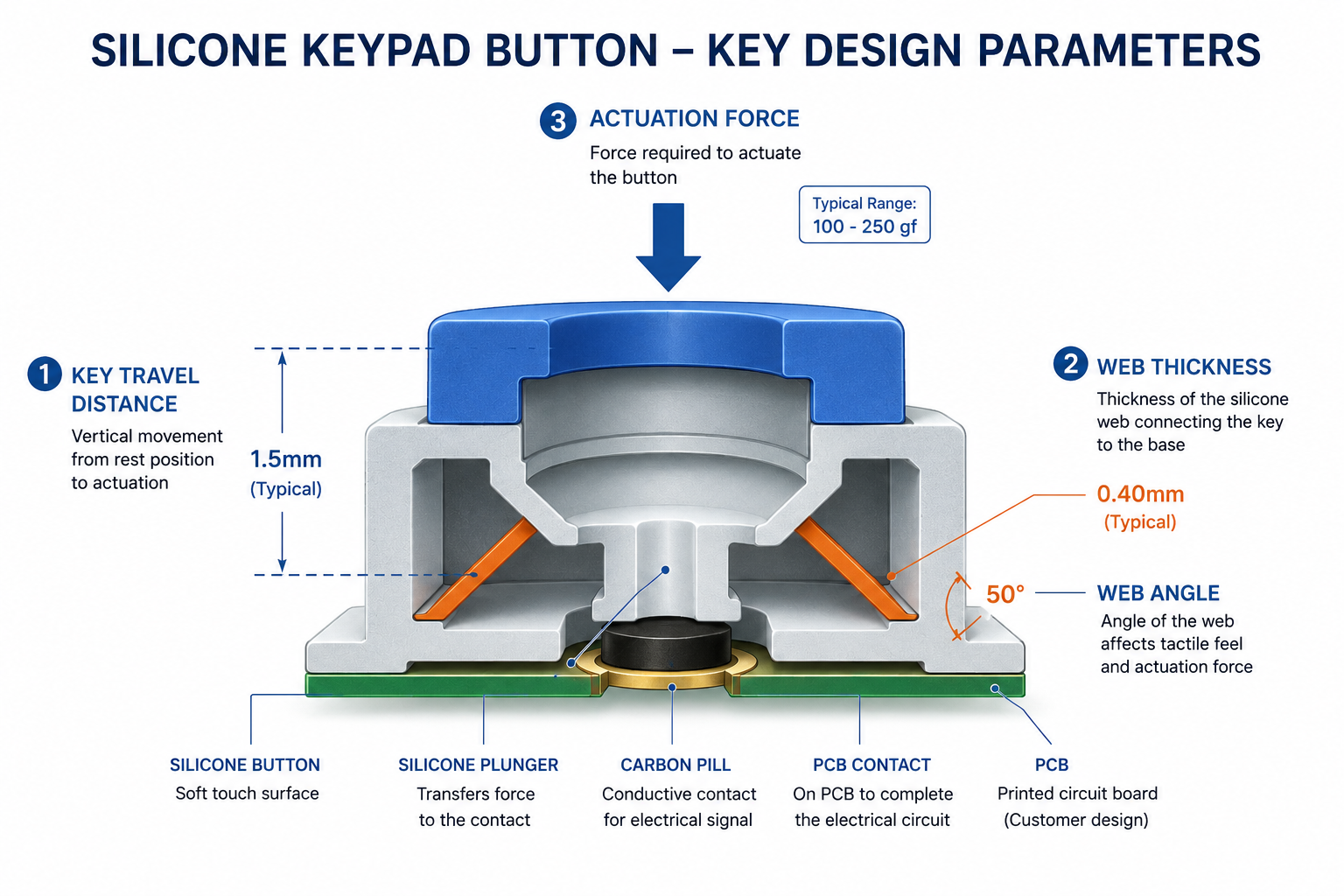
Good design is the difference between a keypad that feels premium and one that feels cheap. I have tested hundreds of keypad samples. The best ones always get these three design features right.
The three critical design features are key travel distance, actuation force, and return speed. These parameters control how the keypad feels to the user and directly impact product quality perception.
Key Travel Distance
Key travel is how far the button moves from rest to fully pressed. Standard silicone keypads have 1.0-2.5mm travel. Short travel (0.5-1.0mm) works for thin devices. Long travel (2.5-4.0mm) gives a more satisfying press.
I usually design for 1.5mm travel as a starting point. It gives enough feedback without requiring too much force.
Actuation Force
Actuation force is the pressure needed to press the button. It is measured in grams. Common ranges are:
| Force Range | Feel | Application |
|---|---|---|
| 100-200g | Light touch | Gaming controllers, frequently used buttons |
| 200-400g | Medium push | Remote controls, general electronics |
| 400-600g | Firm press | Industrial controls, safety buttons |
| 600g+ | Heavy press | Emergency stops, specialized equipment |
The actuation force depends on silicone hardness, web thickness, and button diameter. Thinner webs and softer silicone create lighter force.
Return Speed
Return speed is how quickly the button springs back after release. Good return speed prevents "mushy" feeling. It depends on the silicone elasticity and the web design.
A well-designed web (the thin silicone section connecting the button to the base) should return the button in 50-100 milliseconds. If it returns slower, the keypad feels sticky.
Web Design Tips
The web is the most critical design element. Here are my guidelines:
- Web angle: 45-60 degrees works best for consistent force
- Web thickness: 0.3-0.8mm depending on button size
- Web diameter: Should be 60-80% of button diameter for optimal snap
Getting the web right takes iteration. I always recommend making 3-4 mold revisions before finalizing the design.
How Are Silicone Keypads Manufactured and Finished?
Understanding the manufacturing process helps you design better keypads. I spent two weeks on the factory floor watching keypads being made. That experience changed how I approach every keypad project.
The main production steps are compression or LSR injection molding, followed by secondary processes like silk screen printing, laser engraving, and adhesive assembly. Each step affects the final quality and cost.
Molding Process
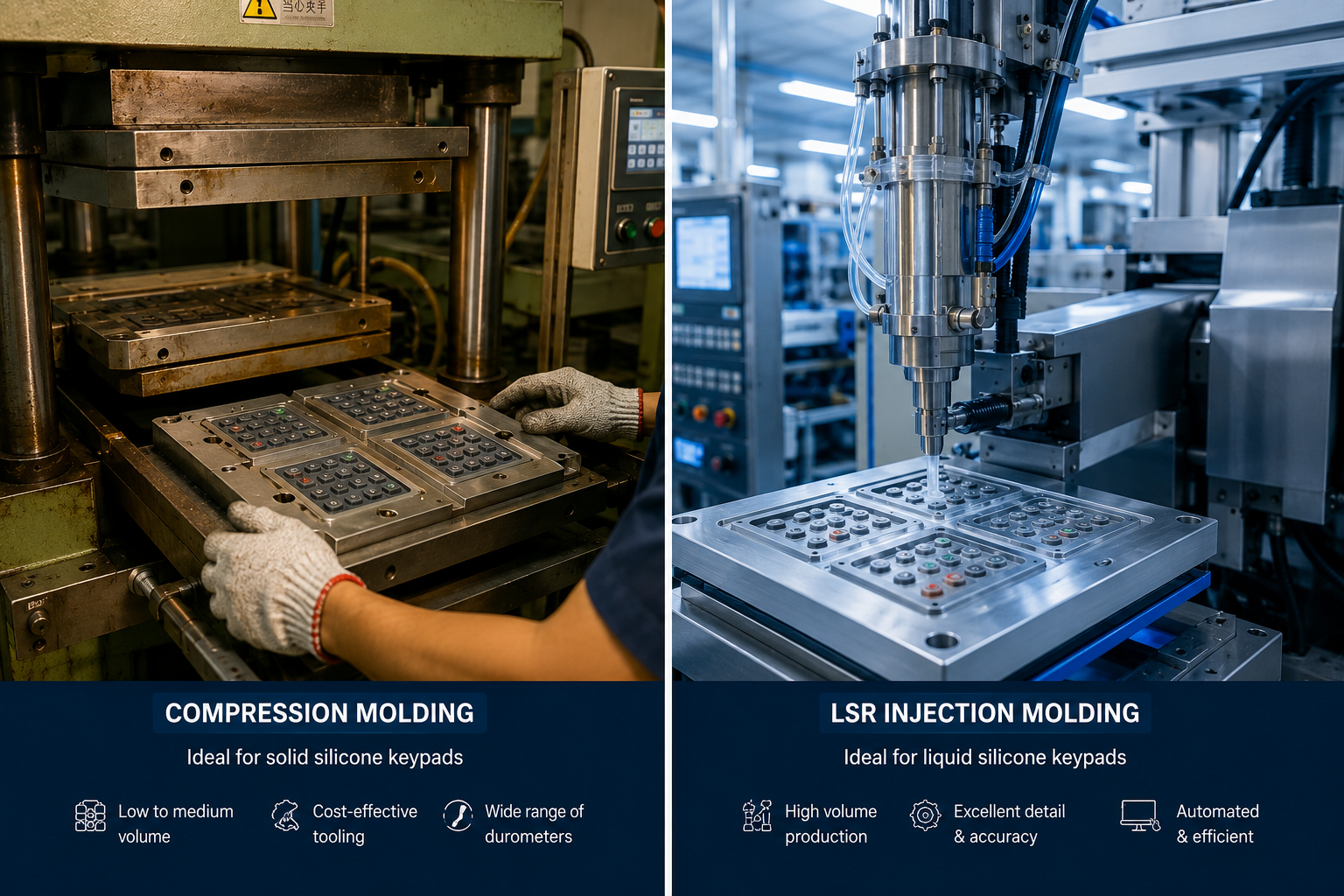
There are two main molding methods:
Compression molding – Silicone compound is placed in a heated mold cavity. The mold closes and pressure cures the silicone. This is the most common method. It works well for medium to high volumes.
LSR (Liquid Silicone Rubber) injection molding – Liquid silicone is injected into a cold mold, then heated to cure. This is faster and better for high-volume production with tight tolerances.
Compression molding is more cost-effective for most keypad projects. LSR is better when you need consistent quality at very high volumes (100,000+ pieces).
Silk Screen Printing
Silk screen printing applies legends, numbers, and icons to the keypad surface. It is the most common method for adding text. The ink bonds well to silicone and can survive millions of presses.
For backlit keypads, we use translucent ink that allows light to pass through the printed areas.
Laser Engraving
Laser engraving removes the top layer of colored silicone to reveal a different color underneath. This creates sharp, precise legends that will never wear off. It is more expensive than silk screen but produces higher quality results.
I recommend laser engraving for premium products and medical devices where durability is critical.
Backlight Assembly
For backlit keypads, the assembly process includes:
- Place LEDs on the PCB
- Install light guide plate
- Mount the silicone keypad over the light guide
- Secure with adhesive or mechanical fasteners
The light guide must align perfectly with the LEDs and keypad windows. Poor alignment causes uneven lighting.
Where Are Silicone Keypads Used in Real-World Applications?
I have worked on silicone keypad projects across many industries. Each industry has unique requirements. Understanding these helps you design keypads that meet specific needs.
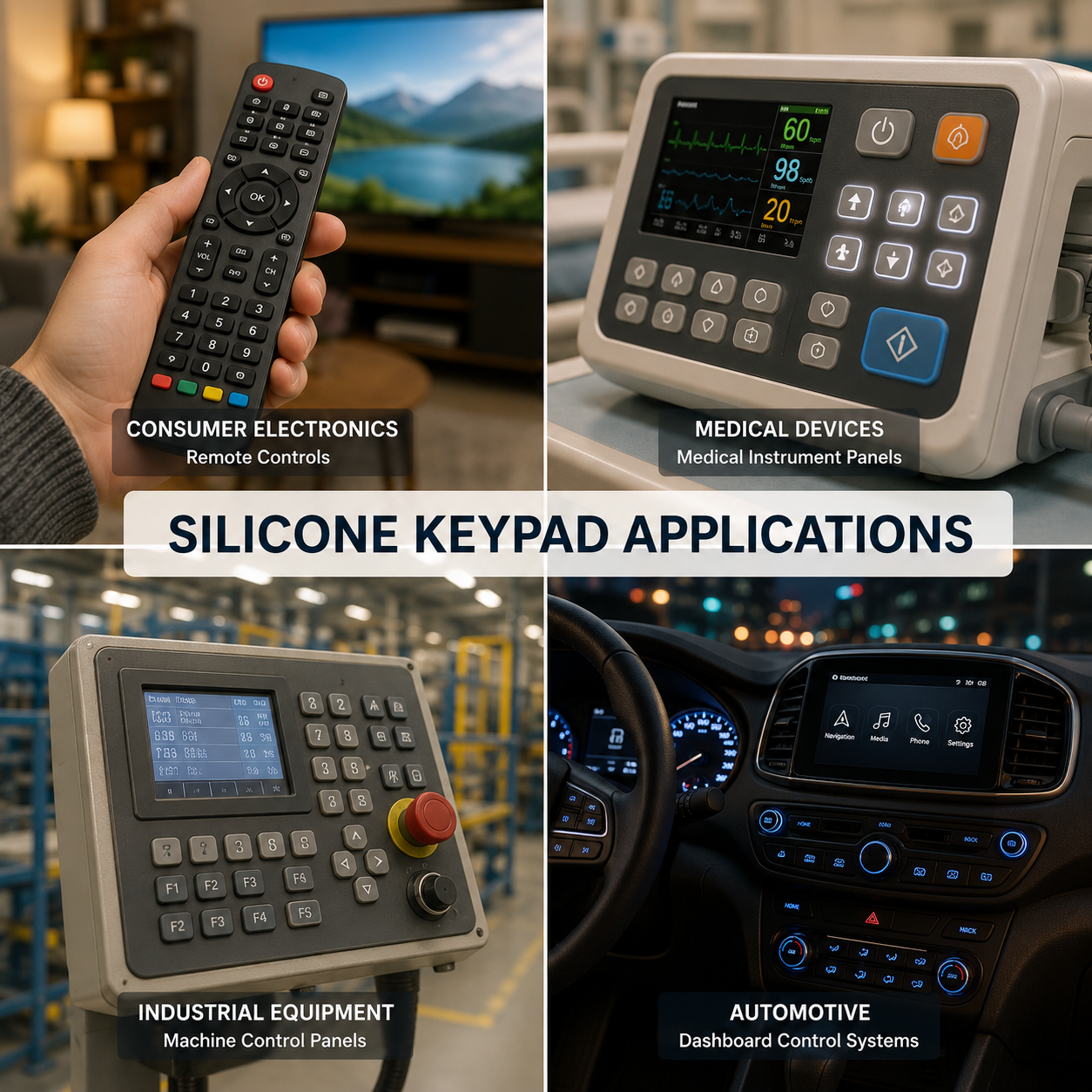
Silicone keypads are used in remote controls, industrial equipment, medical instruments, and automotive control panels. Each application demands different durability, safety, and performance standards.
Remote Controls
Remote controls are the largest market for silicone keypads. They need to survive daily use for 5-10 years. The key requirements are:
- Good tactile feel for repeated pressing
- Conductive contacts for reliable signal
- Backlighting for use in dark rooms
- Low cost for consumer products
Most remote control keypads use 45-55A hardness silicone with carbon pill conductive contacts.
Industrial Equipment
Industrial keypads face harsh conditions. They must resist chemicals, oils, and extreme temperatures. They also need clear tactile feedback so operators know when a button is pressed.
I worked on a factory control panel that needed IP67 waterproofing. We designed the silicone keypad with integral seals around each button. It passed all environmental tests.
Medical Instruments
Medical keypads must meet strict hygiene standards. They need smooth surfaces that are easy to clean. They must resist disinfectants and autoclave sterilization.
Silicone is naturally antibacterial and easy to clean. For medical applications, I use platinum-cured silicone that meets FDA and USP Class VI standards.
Automotive Control Panels
Automotive keypads must work in extreme temperatures from -40°C to 85°C. They need UV resistance for dashboard exposure. Backlighting must be visible in both day and night conditions.
Automotive keypads often combine conductive contacts with tactile feedback. This gives drivers clear confirmation when they press a button while driving.
What Quality Tests Should You Demand from Your Silicone Keypad Supplier?
Quality testing is not optional. I learned this when a batch of keypads failed after only 50,000 presses. The supplier had skipped endurance testing. That mistake cost my client $50,000 in replacements.
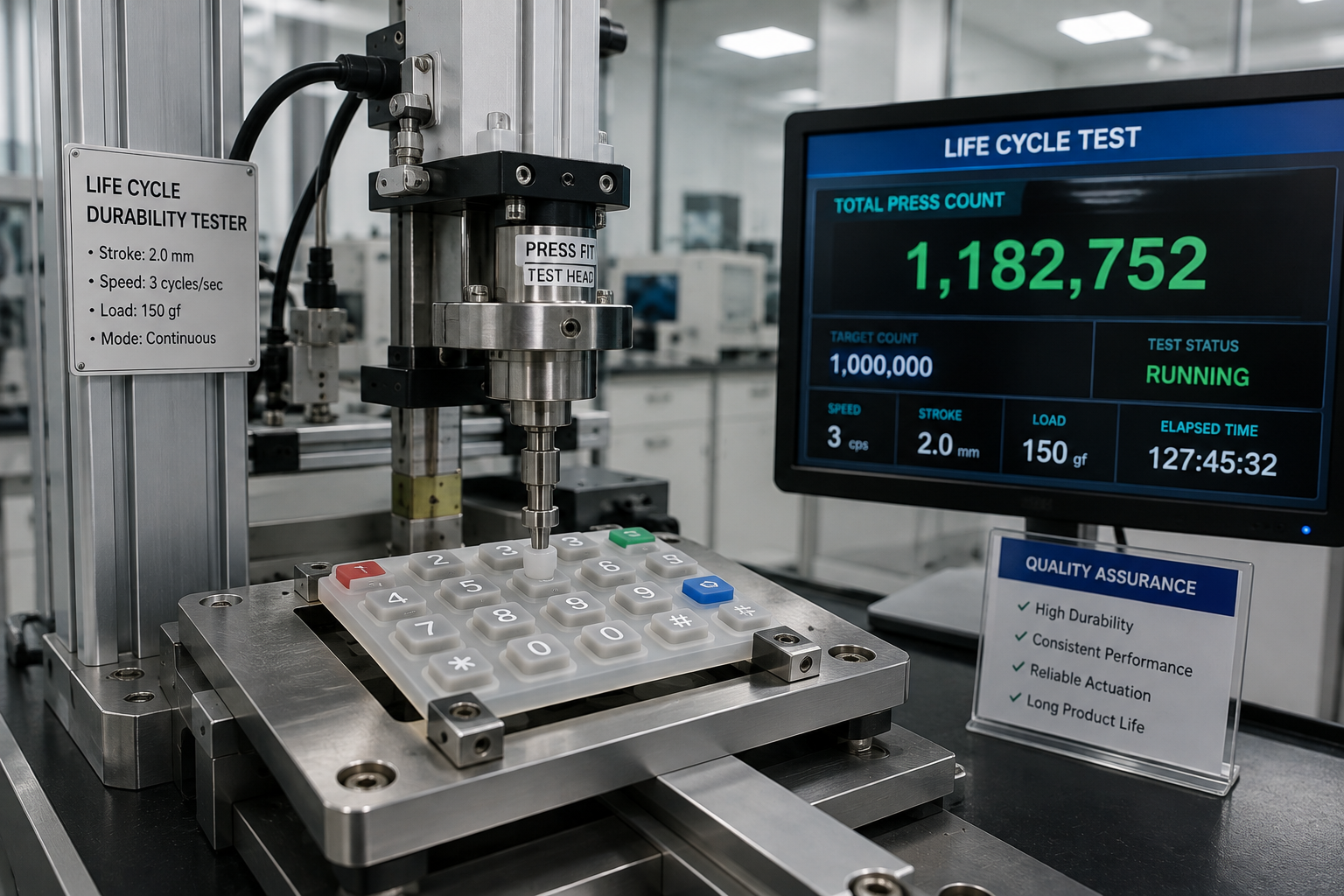
Essential quality tests include life cycle testing (1 million+ presses), tactile force consistency, and environmental resistance. Always demand test reports before approving production.
Life Cycle Testing
Life cycle testing measures how many presses the keypad can survive before failure. Industry standard is 500,000 to 1 million presses. Premium applications require 2-5 million presses.
The test uses automated equipment that presses each button repeatedly while measuring force and electrical resistance. Failure is defined as force change exceeding 20% or electrical resistance change exceeding 50%.
Tactile Force Consistency
Every button on the keypad should feel the same. Force consistency is measured across the keypad surface. The maximum variation should be within ±15% of the target force.
I always request force mapping data that shows the force at each button position. This catches mold issues that cause some buttons to feel different from others.
Environmental Testing
Environmental tests verify the keypad works in real conditions:
| Test | Standard | Requirement |
|---|---|---|
| Temperature cycling | IEC 60068-2-14 | -40°C to 85°C, 100 cycles |
| Humidity resistance | IEC 60068-2-78 | 85°C/85% RH, 500 hours |
| UV exposure | ASTM G154 | 500 hours minimum |
| Chemical resistance | Internal | Alcohol, cleaner, oil exposure |
These tests ensure the keypad will perform in the field for years.
Why Should You Choose Kenvox for Your Custom Silicone Keypad Project?
Choosing the right manufacturing partner is as important as the design itself. I have worked with dozens of suppliers. The difference between a good and bad supplier can make or break your project.
Kenvox offers precision mold making, automated assembly, and competitive pricing with over 35 years of manufacturing experience. Our vertically integrated facility handles everything from design to finished product.
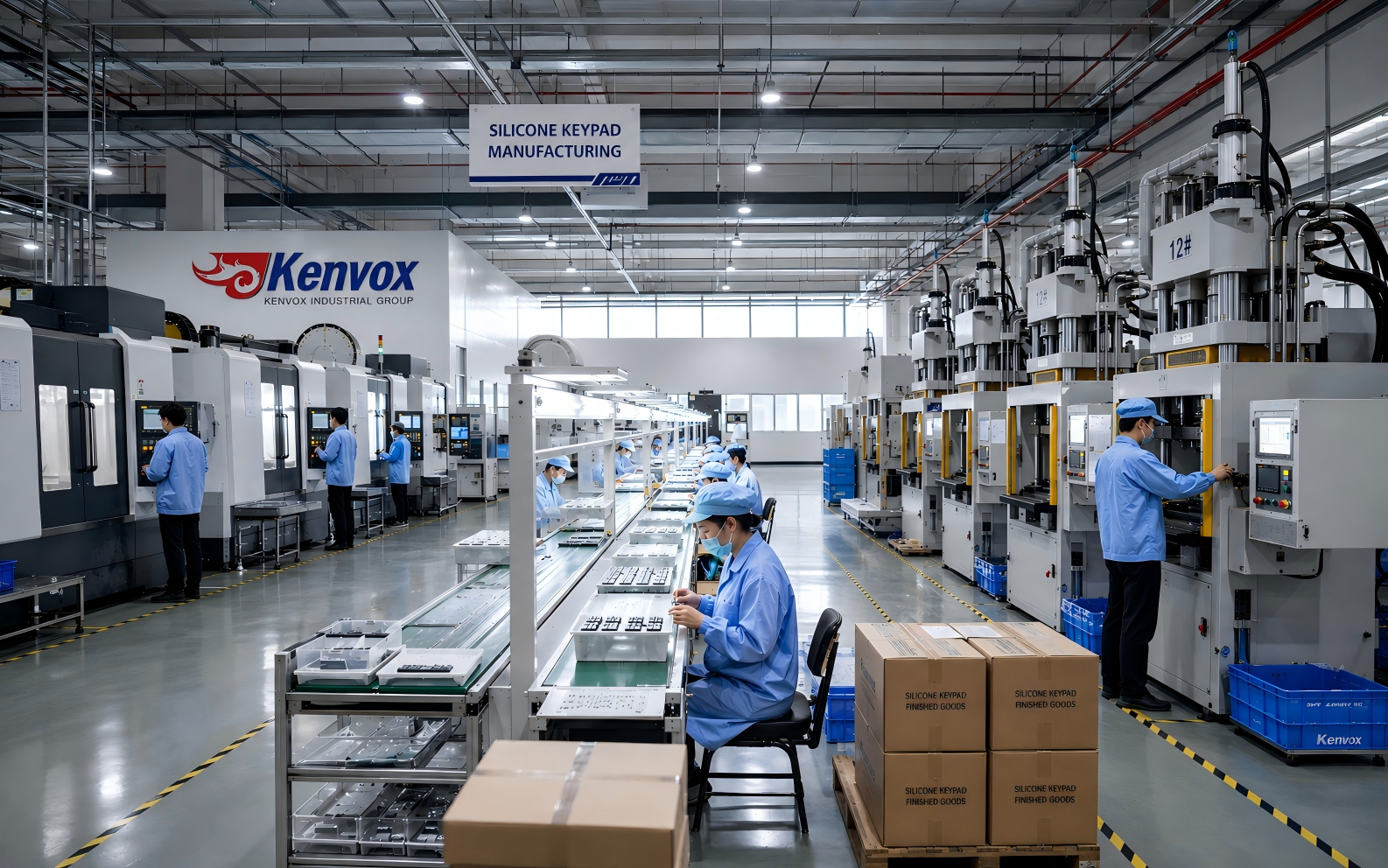
Precision Mold Making
Our mold shop uses high-speed CNC machines from Mikron and DMG. We achieve tolerances of ±0.02mm on critical features. This precision ensures every keypad button feels consistent.
We also use EDM and mirror EDM for fine surface finishes. The mold surface finish directly affects the keypad feel and appearance.
Automated Assembly
Our automated assembly lines handle:
- Conductive carbon pill bonding
- Adhesive application
- LED placement for backlit keypads
- Quality inspection
Automation reduces human error and increases consistency. It also lowers per-piece cost at higher volumes.
Cost Advantage
Our facilities in Dongguan and Vietnam offer competitive labor costs. Combined with our efficient processes, we deliver premium quality at mid-range prices.
For example, a standard 20-button remote control keypad typically costs $0.30-0.80 per piece at volume. We can often beat this by 10-20% while maintaining the same quality standards.
One-Stop Service
Kenvox handles the entire project. You do not need to coordinate multiple suppliers. We manage:
- Design and DFM review
- Prototype and sample molding
- Production tooling
- Mass production
- Secondary processes
- Assembly and packaging
- Export logistics
This saves you time and reduces communication errors.
Frequently Asked Questions About Custom Silicone Keypads
What is the minimum order quantity for custom silicone keypads?
Most suppliers require 1,000-5,000 pieces minimum. At Kenvox, we can start with as few as 500 pieces for standard designs. Tooling costs are the same regardless of quantity.
How long does it take to produce custom silicone keypads?
Typical lead time is 15-25 days for tooling and 7-14 days for production. Rush orders can be completed in 10-12 days for tooling, but this costs more.
Can silicone keypads be made waterproof?
Yes. Silicone keypads can achieve IP67 or IP68 waterproofing with proper design. This requires integral seals around each button and careful mold design.
What colors are available for silicone keypads?
Silicone can be matched to any Pantone color. We can also create multi-color keypads by using different silicone compounds in different mold cavities.
How do I get a quote for my silicone keypad project?
Send us your 2D or 3D drawings with specifications. Include quantity, material requirements, and any special features. We typically respond within 24 hours.
Ready to Bring Your Silicone Keypad Design to Life?
You have read the full guide. You understand the materials, design parameters, and manufacturing processes. Now it is time to take the next step.
Just show us your design or idea, and Kenvox will return you a perfect finished product.
Our engineering team will review your concept and provide:
- Material and hardness recommendations
- Tactile force optimization
- DFM (Design for Manufacturability) analysis
- Detailed cost breakdown
- Sample and production timeline
We handle everything from initial design consultation through mold making, production, and delivery. No coordination headaches. No missed deadlines.
Get Your Custom Keypad Design Solution Today
Get Your Keypad Design Solution →
Send us your 2D drawings, 3D CAD files, or even a rough sketch. We will respond within 24 hours with a tailored design proposal for your project.
KENVOX INDUSTRIAL (HONGKONG) CO., LTD
Established 1989 | Dongguan, Huizhou, Shenzhen, Vietnam
🌐 www.kenvox.com
Precision Silicone Keypads | Custom Mold Manufacturing | One-Stop Turnkey Solutions